Kyle Busch Cause of Death: The Rumor Is False
Kyle Busch cause of death rumors are false. As of August 2026, the two-time NASCAR Cup Series champion is alive, and there is no credible death certificate, family announcement, NASCAR statement, or verified news report confirming his death.
Online death hoaxes can spread quickly when posts use fake screenshots, invented medical details, or copied headlines. This article separates those claims from confirmed facts about Busch and his racing career.
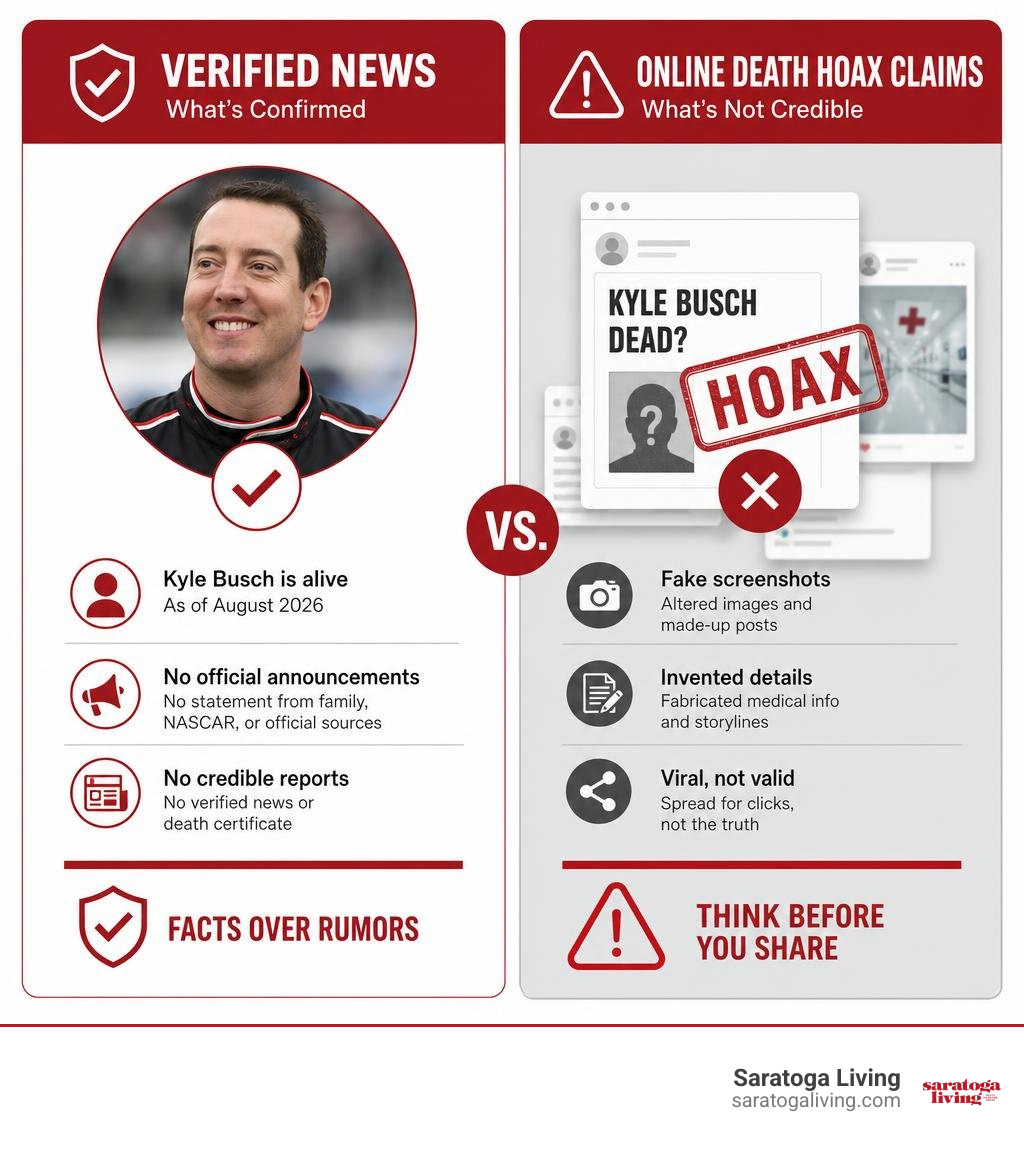
Guest Posts helps Saratoga Living readers sort viral claims from reliable information before the rumors take on a life of their own.
Fact-Checking Viral Rumors vs. Official Reports on Kyle Busch Cause of Death
In today’s hyper-connected digital age, news travels at lightspeed—but so does misinformation. When shocking headlines regarding high-profile figures begin trending across social platforms, distinguishing between sensational viral hoaxes and vetted journalistic reports becomes paramount.
For fans following motorsports coverage, sorting through unverified clickbait requires examining official public records, medical documentation, and direct statements from authorized representatives. Understanding the true context surrounding any news story requires looking directly at verified sources rather than speculative social media posts. For those seeking grounded reporting, reviewing Kyle Busch death certificate reveals new details about driver’s death provides an inside look at how official public filings anchor accurate reporting.
Verifying the Kyle Busch Cause of Death Through Official Records
When public reporting emerges regarding any major figure, official legal documents serve as the absolute baseline of truth. In North Carolina, death certificates filed with county health departments—such as those processed in Mecklenburg County—contain legally binding determinations crafted by certified medical examiners and forensic pathologists.
Official documents specify critical details, including:
- Time and Date of Death: Recorded precisely by medical authorities (noted as 4:37 p.m. ET on May 21, 2026).
- Legal Manner of Death: Categorized under official legal codes as “Natural.”
- Primary and Underlying Causes: The step-by-step biological sequence leading to systemic failure.
- Post-Mortem Arrangements: Official verification of cremation services conducted in Mooresville, North Carolina, following an official autopsy.
By relying strictly on official filings rather than anonymous internet forums, we ensure that our readers receive accurate, factual information free from clickbait exaggeration.
How Online Misinformation Clouded the Medical Kyle Busch Cause of Death
When medical terminology enters public discussion, online rumors often distort complex conditions into sensationalized claims. Misinformation frequently spreads when social media accounts paraphrase medical findings without clinical context.
In the case of severe systemic illness, terms like “sepsis” or “hemorrhagic shock” are easily misunderstood by laypeople online, leading to wild conspiracies or completely fabricated claims. To combat these viral falsehoods, family statements released to accredited media outlets clarify the real timeline of medical events. As documented by the Family of Kyle Busch Reveals Cause of Death – Newsweek report, official family communications exist specifically to ensure the public understands verified medical evaluations rather than social media speculation.
Timeline of Illness: From Sinus Cold to Fatal Complications

To understand how a routine respiratory infection can turn into a critical health emergency, we must trace the chronological sequence of events. What initially appeared to be a minor sinus issue rapidly escalated over a multi-week period.
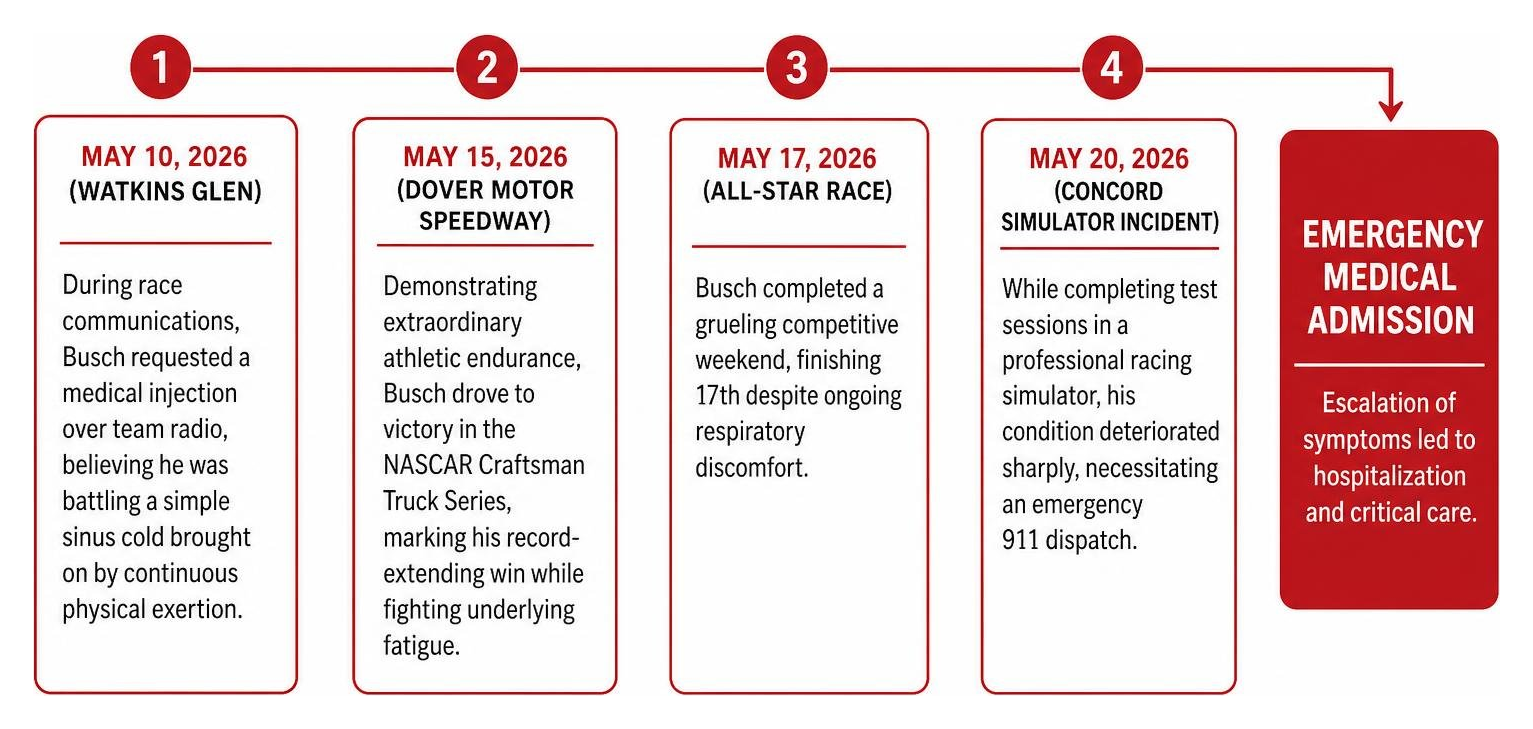
The timeline reveals how persistent physical stress combined with subtle symptoms created a dangerous medical trajectory:
- May 10, 2026 (Watkins Glen): During race communications, Busch requested a medical injection over team radio, believing he was battling a simple sinus cold brought on by continuous physical exertion.
- May 15, 2026 (Dover Motor Speedway): Demonstrating extraordinary athletic endurance, Busch drove to victory in the NASCAR Craftsman Truck Series, marking his record-extending win while fighting underlying fatigue.
- May 17, 2026 (All-Star Race): Busch completed a grueling competitive weekend, finishing 17th despite ongoing respiratory discomfort.
- May 20, 2026 (Concord Simulator Incident): While completing test sessions in a professional racing simulator, his condition deteriorated sharply, necessitating an emergency 911 dispatch.
- May 21, 2026: Despite 24 hours of intensive hospital care, systemic complications proved overwhelming.
The official public health filings, detailed in Kyle Busch’s death certificate says he had pneumonia for ‘days to weeks’ | AP News, confirm that bacterial pneumonia had been quietly developing long before severe symptoms became visibly undeniable.
The Chevrolet Racing Simulator Incident and Emergency 911 Call
The critical turning point occurred on May 20 inside the high-tech Chevrolet racing simulator facility located in Concord, North Carolina. Modern racing simulators recreate extreme track environments, requiring intense focus and physical strain.
During his testing session, Busch collapsed inside the facility’s restroom. Dispatch audio from the emergency 911 call revealed alarming physical distress:
- The caller reported that Busch was experiencing severe shortness of breath and feeling hot.
- He expressed fear that he was going to pass out.
- Most critically, he began coughing up blood—a primary clinical red flag indicating severe pulmonary hemorrhaging and advanced lung damage.
Emergency medical responders arrived rapidly and transported him to a Charlotte hospital, where critical care specialists immediately initiated intensive resuscitation protocols.
Physical Demands, G-Forces, and Delayed Medical Attention
Why would an elite, 41-year-old world-class athlete succumb so rapidly to an infection? Medical experts highlight the unique physiological strain experienced by professional race car drivers, alongside a phenomenon known as “high athletic reserve.”
Athletes in top physical condition possess immense biological tolerance. They are accustomed to pushing through severe physical discomfort, elevated heart rates, and extreme cabin heat exceeding 120°F. Consequently, early warning signs that would sideline an average person are frequently brushed aside as simple fatigue or a routine seasonal bug.
Key physical stressors that exacerbate underlying respiratory infections include:
- Sustained High G-Forces: Rapid acceleration, heavy braking, and steep bank turns exert multi-G pressure on the chest cavity and lungs, forcing infected fluid deeper into tissue.
- Dehydration and Heat Stress: Cabin heat causes rapid fluid loss, thickening pulmonary secretions and hindering the respiratory tract’s ability to clear bacterial pathogens.
- Delayed Seeking of Care: Highly driven competitors often try to “tough it out,” allowing localized bacterial infections to bypass early antibiotic treatment windows.
- Elevation and Barometric Shifts: Traveling between distinct track elevations strains sinus and lung passages, masking pneumonia symptoms under the guise of sinus pressure.
Medical Breakdown: How Bacterial Pneumonia Triggered Fatal Sepsis

Understanding the kyle busch cause of death requires looking at how a localized chest infection transforms into a fatal systemic reaction. The primary culprit in such rapid medical declines is the development of sepsis.
When bacterial pneumonia takes hold, bacteria multiply within the air sacs (alveoli) of the lungs, causing intense local inflammation. If the infection is not halted early with targeted antibiotics, the pathogens—along with inflammatory byproducts—spill across damaged lung tissue directly into the bloodstream.
As outlined in Kyle Busch died after severe pneumonia progressed into sepsis, family says | AP News, this systemic invasion triggers an overactive, uncontrolled immune response known as sepsis. Instead of fighting only the localized bacteria, the immune system unleashes an inflammatory storm throughout the entire circulatory system, damaging healthy blood vessels and organ tissues.
Understanding Disseminated Intravascular Coagulation (DIC) and Hemorrhagic Shock
As sepsis advances unchecked, it can trigger one of the most dangerous complications in critical care medicine: Disseminated Intravascular Coagulation (DIC).
DIC is a complex disorder where the body’s clotting mechanisms go haywire. Initially, thousands of microscopic blood clots form throughout small blood vessels, blocking blood flow to vital organs. As the body exhausts its entire supply of clotting factors and platelets in this chaotic response, the process suddenly flips—leading to uncontrollable, widespread internal bleeding.
| Diagnostic Stage | Clinical Characteristics | Biological Impact |
|---|---|---|
| Bacterial Pneumonia | Persistent cough, fever, localized chest tightness | Bacterial colonization in alveoli and localized lung tissue inflammation |
| Systemic Sepsis | High heart rate, extreme fever/chills, rapid breathing | Immune system triggers widespread inflammation across the vascular system |
| Severe DIC | Depleted platelets, microscopic micro-clots | Blood loses its ability to clot, leading to spontaneous internal mucosal bleeding |
| Hemorrhagic Shock | Rapid drop in blood pressure, organ collapse | Severe internal blood loss prevents oxygen delivery to vital organ systems |
When DIC progresses to systemic blood loss, the circulatory system can no longer maintain adequate blood pressure, resulting in hemorrhagic shock. Despite aggressive modern hospital intervention—including IV fluids, vasopressors, blood transfusions, and mechanical ventilation—hemorrhagic shock stemming from septic DIC carries an extremely high mortality rate.
NASCAR Community Response and Legacy Tributes
The news sent profound shockwaves throughout the global motorsports landscape. Kyle Busch established one of the most formidable legacies in American sports history, earning his place among the absolute titans of racing.
Over his historic career, Busch achieved stats that stand near the top of the all-time record books:
- 234 Total NASCAR National Series Wins: The all-time record across NASCAR’s top three national divisions.
- 63 Cup Series Victories: Ranking 9th on the all-time Cup Series win list.
- 102 Xfinity Series Wins: The undisputed all-time leader in series history.
- 69 Craftsman Truck Series Wins: The undisputed all-time leader in series history.
- Two Cup Series Championships: Claimed in 2015 and 2019 with Joe Gibbs Racing.
- 19 Consecutive Winning Seasons: Demonstrating unprecedented multi-decade elite consistency.
Following the tragic news, Richard Childress Racing (RCR) temporarily parked the iconic No. 8 Chevrolet Camaro ZL1, tapping Austin Hill to step in at Charlotte Motor Speedway. Competitors across the garage displayed commemorative No. 8 decals on 39 race cars during the Coca-Cola 600 weekend, honoring a fierce rival and beloved friend.
NASCAR leadership, including CEO Steve O’Donnell, publicly discussed accelerating Hall of Fame eligibility timelines to honor a driver whose fiery “Rowdy” persona and unmatched talent redefined modern stock car racing. Surviving family members—including his wife, Samantha Busch, and their two children, Brexton (11) and Lennix (4)—received an outpouring of support from millions of fans nationwide.
Frequently Asked Questions About Kyle Busch’s Passing
What was Kyle Busch’s official cause of death?
According to the official death certificate issued in Mecklenburg County, North Carolina, the official cause of death was hemorrhagic shock and disseminated intravascular coagulation (DIC), caused by severe complications from bacterial pneumonia that advanced into sepsis. The official legal manner of death was ruled as natural.
Was Kyle Busch’s death a hoax or real?
Online hoaxes and viral social media rumors frequently confuse fans by circulating fake headlines or misrepresenting minor health updates. Official public health records, family statements, and NASCAR news releases confirm the real events of May 21, 2026, putting an end to online rumors and false claims.
How long was Kyle Busch sick before he passed away?
Medical filings indicate that Busch had been battling underlying symptoms of bacterial pneumonia for “days to weeks” prior to his passing. Initially believing he had a routine sinus cold during races at Watkins Glen and Dover, his condition deteriorated rapidly into septic shock roughly 24 hours before his death.
Conclusion
Kyle Busch’s monumental impact on motorsports remains undeniable. With a record 234 national series victories and two Cup Series championships, his relentless passion, aggressive driving style, and incredible athletic talent earned him an immortal place in racing history.
At Saratoga Living, we believe in bringing our readers clear, authentic, and thoroughly fact-checked reporting on the stories that matter most—whether covering regional sports culture, community milestones, or major national headlines. To explore more of our upscale lifestyle coverage, in-depth sports reporting, and regional highlights, visit Destination Saratoga today.