What Is a Rectangular Prism and How to Identify It
From stacked magazines and restaurant takeout boxes to brick storefronts, shipping cartons, bookshelves, and event displays around Saratoga Springs and New York’s Capital Region, the rectangular prism is one of the most common shapes in everyday design. Understanding it is useful not only in elementary mathematics, but also in architecture, packaging, interior planning, logistics, and the visual layout of community spaces.
To spot a rectangular prism, look for a three-dimensional solid bounded entirely by six flat rectangular faces. Every corner (vertex) forms a 90-degree right angle where three edges meet, which makes it a specific type of regular polyhedron–a multi-sided 3D shape built from flat polygonal sides. In geometric classification, it belongs to the broader category of prisms, which are defined as polyhedra with two congruent, parallel bases connected by lateral faces.
When evaluating a shape in 3D geometry, design, packaging, or teaching spatial reasoning, check for these fundamental structural properties:
- 6 flat faces: Opposite pairs of faces are parallel and congruent (identical in size and shape). Each face shares an edge with four adjacent rectangles.
- 12 edges: Straight line segments where two rectangular faces meet. In a right rectangular prism, these edges form three sets of four parallel lines corresponding to length, width, and height.
- 8 vertices: Corner points where three edges intersect at strict perpendicular right angles.
If you are trying to master basic 3D shape recognition or help students navigate spatial concepts, tools like Rectangular Prism – Definition, Properties, Examples & Questions offer excellent step-by-step guidance. Learning to classify these shapes correctly is standard in elementary mathematics curricula, usually starting with basic shape identification in early grades and moving toward measuring spatial capacity and surface area in upper elementary and middle school.
Right Rectangular Prism vs. Oblique Rectangular Prism
Not all rectangular prisms look like perfect upright boxes. Geometricians categorize them based on the angle at which the lateral faces meet the base faces:
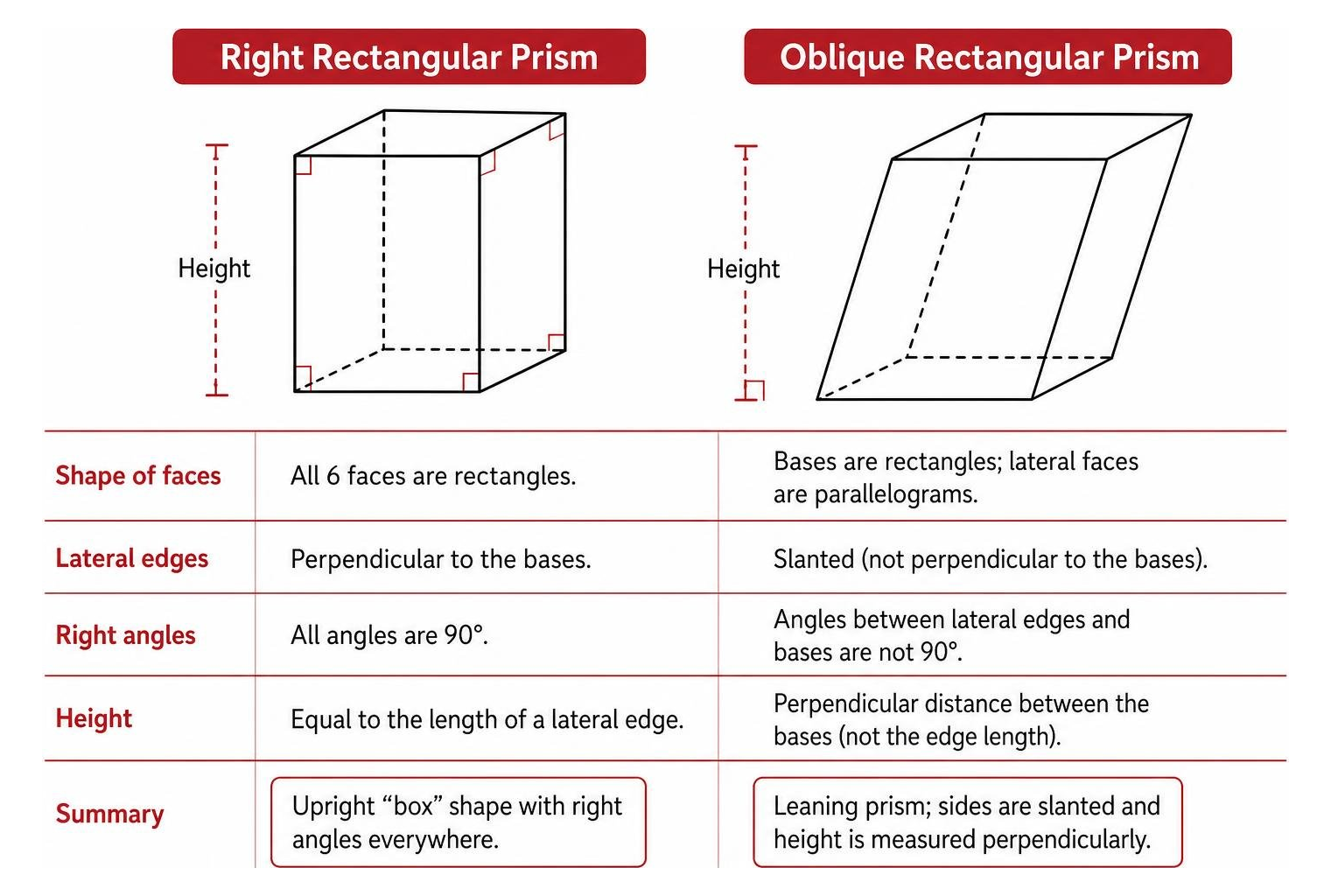
- Right Rectangular Prism: All vertical edges are strictly perpendicular to the base faces, forming right angles everywhere. This is the standard box or cuboid shape we encounter in daily life, such as cereal boxes, shipping crates, books, bricks, retail displays, and storage containers.
- Oblique Rectangular Prism: The joining edges and side faces lean at an angle, meaning they are not perpendicular to the base. The side faces become parallelograms instead of true rectangles, making standard volume calculations slightly different because height must be measured as vertical perpendicular height rather than side edge length.
For a deeper dive into polyhedra classifications across general geometry, refer to Prism (geometry).
Rectangular Prism vs. Cube
A common point of confusion in geometry is the exact distinction between a cube and a rectangular prism. The key rule to remember is that every cube is a rectangular prism, but not every rectangular prism is a cube.
A cube is a special type of right rectangular prism where all three dimensions–length, width, and height–are exactly equal ($l = w = h$). Because square faces qualify as regular rectangles, a cube simply represents the most symmetrical version of a cuboid, connecting basic 3D shapes to the Platonic solids.
| Feature | Rectangular Prism (General Cuboid) | Cube (Special Rectangular Prism) |
|---|---|---|
| Face Shapes | 6 rectangles (opposite pairs equal) | 6 identical squares |
| Edge Lengths | Can have distinct lengths ($l |
eq w eq h$) | All 12 edges equal ($l = w = h$) | | Symmetry | Symmetric along opposite face axes | Highly symmetric (Platonic solid) | | Angles | All interior corner angles are 90 degrees | All interior corner angles are 90 degrees |
Geometric Properties and Nets of a Rectangular Prism
Beyond counting edges and vertices, a rectangular prism possesses unique spatial relationships and geometric characteristics:
- Dihedral Angles: Every meeting edge between two faces forms a 90-degree dihedral angle in a right rectangular prism, ensuring uniform right-angled corners throughout the solid.
- Corner-to-Face Ratio: With 8 vertices and 6 faces, the corner-to-face ratio is 8:6, which simplifies neatly to 4:3. This proportional ratio is useful when analyzing convex polyhedra.
- Face Congruence: The six faces are arranged into three distinct pairs of congruent rectangles. Each pair of opposite faces is equal in area and lies in parallel planes.
- Euler’s Formula: Like all convex polyhedra, it follows Euler’s formula ($V – E + F = 2$). Substituting 8 vertices ($V$), 12 edges ($E$), and 6 faces ($F$) yields $8 – 12 + 6 = 2$, proving its structural validity.
Understanding the Net of a Rectangular Prism
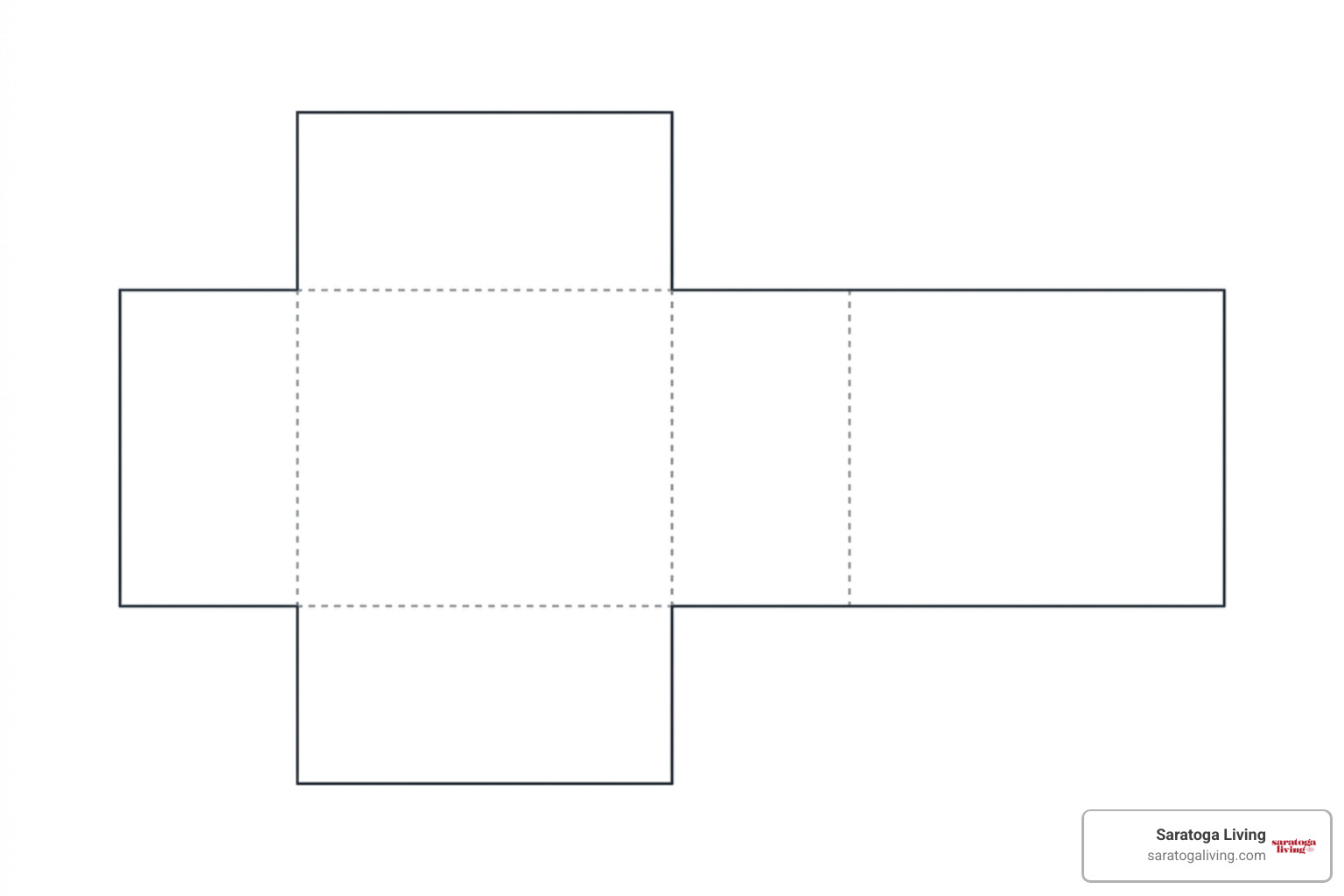
The net of a rectangular prism is a two-dimensional flat layout that can be folded along its edges to construct the complete 3D solid shape. Unfolding a box lets us easily see all six rectangular faces laid flat at once, helping students transition between 2D geometry and 3D spatial thinking.
While a standard cube has 11 distinct folding nets, a general rectangular cuboid with three different side lengths has at least 54 distinct net layouts! Printable PDF templates and paper model crafting projects use these flat nets in elementary math classrooms to build spatial visualization skills, allowing learners to understand how surface area maps directly onto three-dimensional objects.
Mathematical Formulas for a Rectangular Prism
When working with a rectangular prism, three fundamental dimensions define its size: length ($l$), width ($w$), and height ($h$). You can calculate spatial capacity, surface coverage, or internal distance using handy digital tools like the Rectangular Prism Calculator or standard algebraic formulas.
Calculating Volume of a Rectangular Prism
Volume measures the total three-dimensional space enclosed inside a solid, expressed in cubic units (e.g., $text{cm}^3$, $text{in}^3$, $text{m}^3$). You can visualize this as stacking $1 times 1 times 1$ unit cubes to fill a container completely without leaving gaps.
The volume formula is: $$V = l times w times h$$
Worked Example: Suppose we want to find the volume of a fish tank that measures 10 inches long, 5 inches wide, and 4 inches high.
- Identify the given dimensions: $l = 10 text{ in}$, $w = 5 text{ in}$, $h = 4 text{ in}$.
- Multiply the dimensions together: $V = 10 times 5 times 4$.
- Calculate the result: $V = 200 text{ cubic inches}$.
Calculating Surface Area of a Rectangular Prism
Surface area measures the total outer area covering all six faces, expressed in square units (e.g., $text{cm}^2$, $text{in}^2$).
- Total Surface Area (TSA): Sums all six outer faces (top, bottom, front, back, left, right). Because opposite faces are equal pairs, we double each pair: $$text{TSA} = 2(lw + lh + wh)$$
- Lateral Surface Area (LSA): Measures only the four side faces, excluding the top and bottom bases. This is useful for calculating the wall area of a room or wrapping the sides of a box: $$text{LSA} = 2(lh + wh) = 2h(l + w)$$
Worked Example: How much wrapping paper is required to completely cover a gift box measuring 15 inches long, 10 inches wide, and 8 inches high?
- Calculate individual face areas: $lw = 15 times 10 = 150$, $lh = 15 times 8 = 120$, $wh = 10 times 8 = 80$.
- Add the three areas: $150 + 120 + 80 = 350 text{ sq in}$.
- Multiply by 2 for total surface area: $text{TSA} = 2 times 350 = 700 text{ square inches}$.
Calculating the Diagonal of a Rectangular Prism
The space diagonal ($d$) is the straight line distance connecting one corner vertex to the furthest opposite interior corner. It extends the 2D Pythagorean theorem into 3D space:
$$text{Diagonal } d = sqrt{l^2 + w^2 + h^2}$$
Worked Example: To calculate the space diagonal of a box with $l = 3$, $w = 4$, and $h = 12$: $$d = sqrt{3^2 + 4^2 + 12^2} = sqrt{9 + 16 + 144} = sqrt{169} = 13$$
To learn more about advanced spatial properties of cuboids, check out Rectangular cuboid.
Real-Life Applications and Everyday Examples

Because rectangular cuboids stack seamlessly without leaving open space (a property called spatial tessellation), human engineering relies heavily on this shape for storage, architecture, packaging, and logistics. Unlike spheres or cylinder shapes that create wasted dead space when grouped, rectangular solids pack together tightly to optimize space utilization.
That is why rectangular prisms show up constantly in the kinds of places Saratoga Living covers: homes, restaurants, galleries, offices, retail shops, schools, barns, event venues, and hospitality spaces throughout Saratoga Springs and the Capital Region. Whether someone is arranging books on a shelf, estimating storage for an event, designing product packaging, or looking at the brickwork and box-like volumes of a building, the same geometric idea is at work.
Everyday examples include:
- Shoeboxes and Gift Boxes: Easy to manufacture, wrap, store in closets, and stack efficiently on retail store shelves.
- House Bricks and Masonry: Designed to interlock and stack smoothly during building construction, providing structural stability for walls and foundations.
- Hardcover Books, Magazines, and Laptops: Portable, rectangular designs optimized for easy packing, handling, and fitting into backpacks, bookshelves, desks, and display tables.
- Cargo Shipping Containers: Standardized rectangular prisms maximize global shipping container vessel capacity, train transport, and warehouse logistics through uniform modular stacking.
- Appliances and Furniture: Refrigerators, washing machines, microwaves, cabinets, tables, and storage units fit flush against flat room walls to conserve floor space in interior architecture.
- Event and Retail Displays: Risers, signage bases, product boxes, and display cubes often use rectangular-prism forms because they are stable, stackable, and easy to measure.
Frequently Asked Questions About Rectangular Prisms
What is another name for a rectangular prism?
A rectangular prism is mathematically known as a cuboid, a rectangular box, a rectangular hexahedron, or an orthogonal parallelepiped. In non-technical everyday English, it is simply referred to as a box or rectangular block.
How many edges, faces, and vertices does a rectangular prism have?
It features 6 rectangular faces, 12 edges, and 8 vertices. This gives it a corner-to-face ratio of 8:6 (which simplifies to 4:3) and ensures it satisfies Euler’s formula ($8 – 12 + 6 = 2$).
Can a rectangular prism have square faces?
Yes! If two opposite base faces are square while the remaining four side faces are rectangles, it is called a right square prism. If all six faces are squares, it becomes a cube, which is the most symmetrical form of a rectangular prism.
Conclusion
Mastering the properties of a rectangular prism gives us a clearer appreciation for the geometry surrounding us every day–from home construction and packaging design to calculating capacities in school math projects, arranging displays, or understanding how everyday objects fit into a room, shelf, stable, shop, or event space. Understanding how length, width, and height interact allows students, builders, designers, retailers, and organizers to calculate volume, surface area, and spatial limits with ease.
At Saratoga Living, we love breaking down educational, cultural, and lifestyle concepts to make complex topics clear, warm, and engaging. Whether you are exploring practical math concepts, local design, regional events, food, culture, sports, or the built environment of Saratoga Springs and New York’s Capital Region, structured knowledge enriches our daily environment.
Want to explore more lifestyle guides, educational roundups, and local news across Saratoga Springs and New York’s Capital Region? Explore Saratoga Living Content to keep learning with us!