What Is Graph Paper and Why Does It Matter?
Graph paper is paper printed with a regular grid of fine lines or dots. Those marks make it easier to measure, align, plot, and draw accurately without reaching for a ruler every few seconds.
| Quick answer | What it means |
|---|---|
| Common uses | Math graphs, engineering sketches, floor plans, charts, and design layouts |
| Most familiar type | Square-grid, or quadrille, paper |
| Common sizes | 1/4-inch squares, 5 mm squares, and 10 squares per inch |
| Specialized options | Isometric for 3D sketches, polar for angles, and logarithmic paper for data across large ranges |
| Where to get it | Notebooks, tear-off pads, loose-leaf sheets, printable PDFs, and browser-based drawing tools |
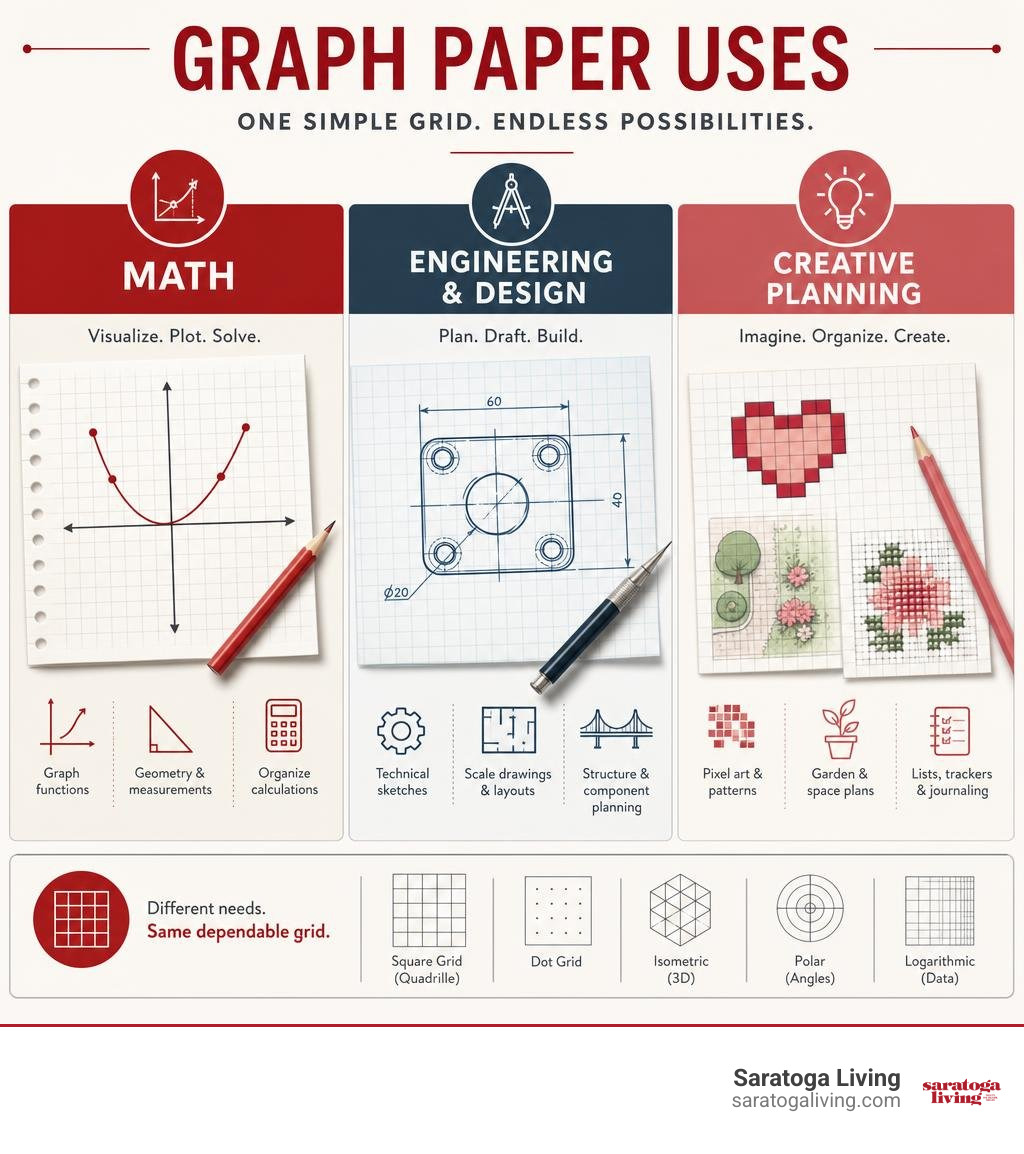
It is a simple tool with a long reach. Students use it to keep equations tidy. Engineers and designers use it to turn rough ideas into scale drawings. Creatives use it for cross-stitch charts, garden plans, bullet journals, pixel art, and puzzle design.
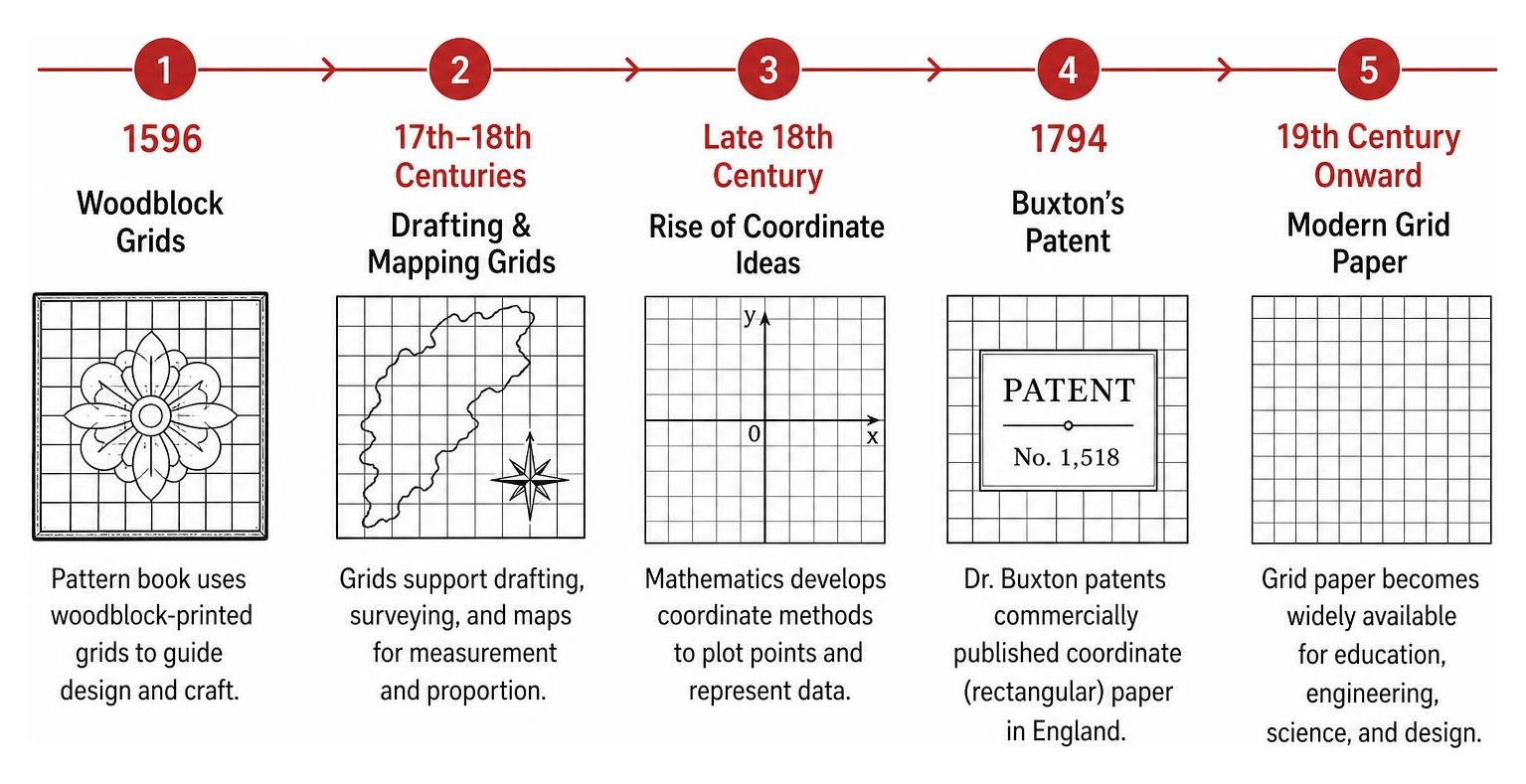
The idea is not new, either. A pattern book from about 1596, now held by the Metropolitan Museum of Art, used woodblock-printed grids to help organize visual designs. By 1794, England’s Dr. Buxton had patented commercially published coordinate paper with a rectangular grid.
Whether you need a clean page for a quick seating plan before an event, a dependable notebook for technical notes, or a printable grid for a hobby project, the right format can make the work clearer and faster.
Guest Posts brings practical guides like this one to Saratoga Living readers who value smart, well-made everyday tools.
Easy graph paper glossary:
History and Evolution of Grid Sheets
When we look at a crisp sheet of graph paper today, it is easy to assume it is a modern product of industrial printing. However, structured grid systems have a fascinating historical arc spanning centuries. From Renaissance block pictures to early British patent offices, grids have consistently emerged whenever humans needed to translate spatial thoughts into structured visual media.
Precursors from 1596 Woodblocks
The conceptual seeds of grid-based drafting were planted long before modern mathematics classrooms standardized coordinate systems. The Metropolitan Museum of Art preserves a remarkable pattern book dated to around 1596. In this historic work, each page features fine grids printed directly with woodblocks.
Craftspeople used these printed boxes as guides for intricate lace work, textiles, and mosaic tile layouts. Functionally, this 16th-century pattern book acted like a physical forerunner to pixel art templates. Artisans filled individual squares to construct larger geometric figures, illustrating how fundamental the grid is for converting abstract patterns into tangible craftwork.
The 1794 Coordinate Paper Patent
The transition from decorative craft guides to standardized mathematical tools took a massive leap forward in the late 18th century. Dr. Buxton of England is generally recognized as the inventor of commercially published “coordinate paper,” securing a patent in 1794 for paper printed with a rectangular coordinate grid.
Dr. Buxton’s innovation allowed scientists, surveyors, and mathematicians to plot functions and record physical measurements directly onto uniform paper formats. Over the 19th and 20th centuries, terminology evolved across different regions. While British academics frequently referred to these pages as “squared paper,” American schools and technical firms adopted terms like “quadrille paper,” “quad paper,” or simply graph paper. By the early 1900s, math educators actively debated the pedagogical merits of various scales, eventually cementing grid sheets as standard equipment in academic and laboratory settings worldwide.
Types of Graph Paper and Their Key Applications
Not all grid patterns serve the same purpose. Over decades of specialized drafting, specific grid geometry has evolved to solve unique mathematical, engineering, and artistic problems. Choosing the correct grid type ensures your drawings remain clean, accurate, and easy to interpret.
Cartesian Quad and Dot Grid Patterns
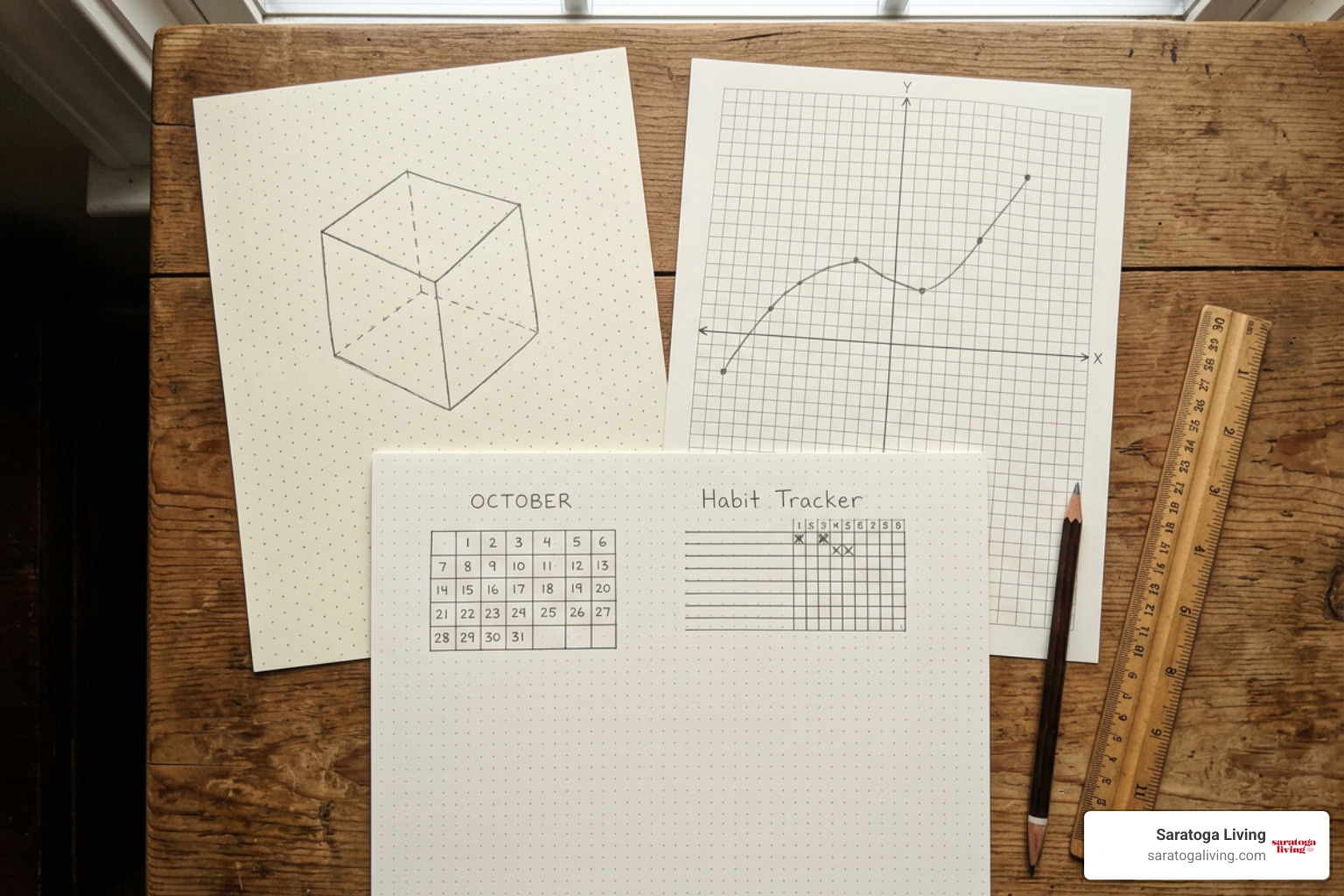
Standard Cartesian grid paper, often termed quadrille or quad paper, features equally spaced horizontal and vertical lines crossing at 90-degree angles. The most prevalent academic format is 4×4 quad ruling, which provides four grid squares per linear inch (creating 16 individual squares per square inch). Metric variations typically rely on 5 mm or 1 cm cell dimensions. These perpendicular grids are ideal for basic algebra, geometry, line graphs, and two-dimensional floor plans.
For those who prefer a subtler visual structure, dot grid paper replaces solid printed lines with small, faint dots at exact intersection coordinates. Dot grid paper gained massive popularity through bullet journaling because it offers visual alignment for handwriting and sketch boxes without cluttering the page. If you need simple, unobtrusive grids for daily sketching or note alignment, you can easily generate clean templates using Free Online Graph Paper / Plain.
Isometric Graph Paper for 3D Sketching
When standard two-dimensional grids fall short, isometric graph paper provides the ideal foundation for pseudo-three-dimensional representations. Isometric paper uses a network of three sets of parallel guidelines angled at 60 degrees to one another, forming a continuous field of small equilateral triangles.
Because the primary vertical and diagonal axes reflect 30-degree angles from the horizontal plane, artists, architects, and woodworkers can draw 3D objects—such as furniture frames, architectural structures, and mechanical parts—to true scale along all three spatial dimensions without vertical distortion.
Logarithmic, Polar, and Engineering Grids
For scientific research and advanced engineering, highly specialized grid layouts are required:
- Semi-Log Paper: Combines a linear axis with a logarithmic axis. It is essential when plotting exponential relationships, such as tracking bacterial growth over time or evaluating financial compound interest.
- Log-Log Paper: Features logarithmic scales on both horizontal and vertical axes. This layout turns power-law curves into straight lines, making it easy to analyze phenomena like earthquake frequency versus magnitude.
- Polar Coordinate Paper: Replaces rectangular coordinates with concentric circles intersected by radial lines radiating from a central pole point. Angles are marked in degrees or radians, making it perfect for plotting navigation paths, radar signals, and circular antenna patterns.
- Engineering Paper: Designed specifically for technical problem sets and calculations, this format utilizes light green or tan translucent paper with fine grids printed on the reverse side. The grid lines show through softly to guide your pen, but they disappear on photocopies and digital scans for a perfectly clean presentation.
| Graph Paper Type | Primary Geometry | Best Real-World Use Cases |
|---|---|---|
| Cartesian Quad | 90° Orthogonal Lines | Algebra homework, basic bar/line charts, 2D floor plans |
| Dot Grid | Fine Matrix Dots | Bullet journaling, UI wireframing, handwriting practice |
| Isometric Grid | 60° Triangular Axes | 3D mechanical sketches, woodworking, pipeline drafting |
| Semi-Log Paper | Linear x Logarithmic | Exponential growth modeling, acoustics, decay rate charts |
| Polar Grid | Concentric Rings & Radial Rays | Antenna radiation patterns, physics vector fields, navigation |
| Engineering Grid | Back-printed 5×5 Grid | Structural engineering homework, scan-ready calculations |
Creative Uses for Printable Graph Paper
While graph paper is deeply rooted in STEM fields, creative communities have embraced grid layouts for artistic projects. The fiber arts market, which exceeded $10 billion in 2025, relies heavily on grid paper for mapping cross-stitch, tapestry crochet, and knitting colorwork patterns. Each grid box translates directly to an individual stitch or pixel.
Beyond textiles, spatial planners use large-format grid pads for garden layout planning, calculating plant spacing per square foot. Music composers utilize specialized multi-line grid paper to draft piano-roll notation, mapping pitch vertically against time horizontally. Parents and teachers also rely on wide-ruled graph paper to guide children’s handwriting, using three-row grid blocks to teach proper letter height, ascenders, and descenders. You can design tailored templates for any of these creative projects using the Free Printable Graph Paper Generator — Custom PDF | CustomGraph.
Standard Grid Sizes, Formats, and Buying Factors
Selecting the right physical pad or notebook requires understanding grid scales, paper weights, and manufacturing finishes. Matching sheet parameters to your writing instrument prevents ink bleed and guarantees durable documentation.

Standard Grid Sizes and Dimensional Formats
Grid scale dictates precision. Depending on your region and discipline, you will encounter several standardized grid densities:
- 1/4 Inch (4×4): Four squares per inch; the classic universal choice for school math and general note-taking.
- 5 mm Grid: The standard metric layout, offering slightly tighter box spacing than 1/4 inch (about 5.08 squares per inch), widely favored in bullet journals and executive notebooks.
- 10 Squares per Inch (10×10): Fine cross-section paper used for high-precision laboratory graphing and detailed engineering drafts.
- 1/8 Inch & 1/2 Inch Grids: 1/8 inch provides ultra-dense grids for detailed drafting, while 1/2 inch or 1 inch grids serve young students developing fine motor skills or presenters creating visible charts.
Paper dimensions also matter. Standard American Letter size (8.5 x 11 inches) and international A4 (210 x 297 mm) suit daily folder storage. For architectural blueprints and large schematics, oversized formats like 11 x 17 inches (Tabloid), 17 x 22 inches, or massive 24 x 36 inches drafting pads offer ample workspace for grand designs.
Paper Weight, Binding, and Paper Quality
To ensure a pleasant drawing experience, evaluate these structural paper characteristics before buying:
- Paper Weight (GSM / LB): Lightweight loose-leaf paper typically sits around 54 to 70 GSM (15 to 20 lb), which works fine for standard pencil work but may allow ink bleed-through with heavy pens. Superior notebook paper ranges from 90 to 100 GSM (24 to 28 lb), delivering a thick, opaque surface capable of handling gel pens and fountain pens without feathering.
- Archival & Stock Quality: Look for acid-free, pH-neutral paper stock with a smooth satin finish. Acid-free paper prevents yellowing and degradation over time, preserving long-term archival projects, engineering notebooks, and personal journals.
- Binding & Perforations: Choose loose-leaf 3-hole punched paper for binder organization. For desk work, top-glued perforated tear-off pads allow clean removal of individual sheets. Spiral-bound notebooks lie completely flat on desks, whereas heavy-duty softcover or leatherbound journals offer portability for field work.
Digital Generators, Virtual Tools, and Printing Best Practices
While physical pads remain popular, digital grid tools offer incredible customization. Modern vector PDF generators allow you to tailor line colors, margins, and grid scales directly inside your browser.
Virtual Generators and Online Tools
Digital tools give you complete control over your page geometry. Web platforms like CustomGraph offer over 800 million potential grid configurations, letting you tweak line weights, cell sizes, and hex colors in real time.
Digital tools cater to diverse output needs:
- Vector PDF Downloads: Vector files rely on mathematical paths rather than pixels, ensuring line work prints with crystal clarity on any paper dimension.
- Image Exports (PNG & SVG): High-resolution PNGs (often rendered at 2x DPI) and editable SVG vector graphics are ideal for importing directly into digital drawing apps or tablet apps.
- Browser-Based Drawing Canvases: Virtual canvas tools let you sketch ideas directly on screen and share work via unique URLs valid for up to 90 days.
To quickly configure instant, print-ready PDF sheets without account signups or watermarks, explore the Free Printable Graph Paper Generator | A4 & US Letter PDF.
Best Practices for Printing Accurate Grids
Printing a printable PDF grid seems simple, but default printer driver settings can distort exact measurements. Standard printer software automatically scales documents down by 4% to 5% to fit inside home printer margins, altering grid square dimensions.
To achieve exact physical scale (where a 5 mm grid measures exactly 25.0 mm across 5 boxes):
- Disable “Fit to Page”: In your printer dialog box, turn off “Fit to Page,” “Scale to Fit,” or “Shrink to Printable Area.”
- Select 100% / Actual Size: Always set print scaling explicitly to “100%” or “Actual Size.” Vector PDFs define dimensions in exact PostScript points (1 point = 1/72 inch), preserving physical dimensions when scaled properly.
- Maintain Safe Hardware Margins: Most home inkjet and laser printers have an unprintable hardware outer dead zone of approximately 4 to 5 mm. Set layout margins to at least 0.25 inches (6.35 mm) to prevent edge lines from disappearing.
- Validate with a Physical Ruler: After printing, verify precision by placing a physical ruler across ten grid boxes to confirm the overall distance matches your target dimensions exactly.
For mathematically guaranteed scaling that embedding exact MediaBox point dimensions into vector downloads, test your printer setup with the Graph Paper Generator — Printable PDF, True-to-Scale.
Frequently Asked Questions
How do I ensure printed grids remain true-to-scale?
Open your PDF reader, access the print setup dialog, set scaling to “100%” or “Actual Size,” and disable any “Fit to Page” options. Ensure margins exceed 0.25 inches (6.35 mm) so your printer does not trim edge lines. Always confirm accuracy by measuring printed grid boxes with a physical ruler.
What is the difference between quad paper and engineering paper?
Quad paper features standard white stock with high-contrast grid lines printed on the front side, making it ideal for general academic math. Engineering paper utilizes light green or tan translucent stock with 5×5 grid lines printed exclusively on the back side. The grid shows through faintly for writing guidance but disappears completely when photocopied or digitally scanned.
Why are grid lines printed on the back of engineering sheets?
Back-printing grid lines on translucent paper allows users to write on a smooth front surface without pencil leads skipping over printed ink. More importantly, when the page is laid flat against copier glass or passed through a document scanner, direct light reflects off the back surface, causing grid lines to vanish and yielding crisp, scan-ready calculations.
Conclusion
From Renaissance woodblocks in 1596 to modern web-based vector generators, graph paper remains an essential layout tool across mathematics, engineering, science, and creative crafts. Whether you rely on 4×4 quad filler paper for algebra assignments, 30-degree isometric grids for 3D drafting, or dot grid notebooks for daily organization, selecting the proper layout dramatically improves work quality.
At Saratoga Living, we celebrate thoughtful design and functional craftsmanship in every area of daily life. Exploring clean, custom layouts for work or personal projects helps keep your ideas organized, precise, and visually engaging. Learn more about lifestyle design, community culture, and regional updates by reading Destination Saratoga.