How Did Michael Jackson Die? The Short Answer
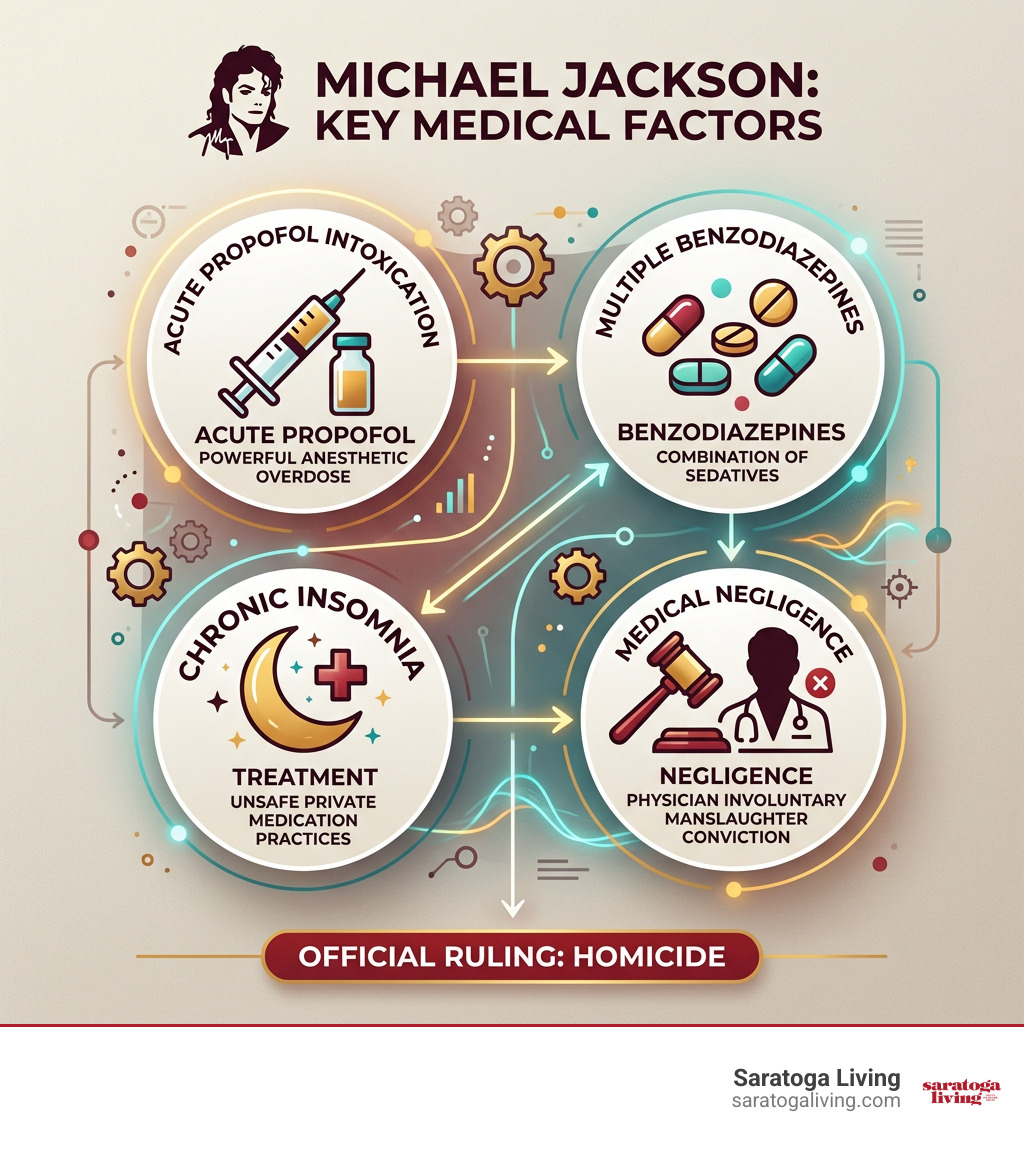
How did Michael Jackson die? Michael Jackson died on June 25, 2009, at age 50 from acute propofol intoxication. The Los Angeles County coroner found that the powerful anesthetic propofol, used alongside sedatives including benzodiazepines, caused his fatal collapse.
His death was officially ruled a homicide, meaning it resulted from another person’s actions rather than natural causes. His personal physician, Dr. Conrad Murray, later was convicted of involuntary manslaughter for unsafe medical care in Jackson’s Los Angeles home.
What began as a private effort to treat severe insomnia became one of the most closely examined medical and legal cases in modern pop culture. The news shocked fans worldwide and sparked hard questions about prescription drugs, physician responsibility, and the pressure behind a major comeback tour.
Guest Posts brings you this clear look at the facts, beginning with the official medical findings and the events that followed.
How did michael jackson die basics:
Official Cause: How Did Michael Jackson Die Medically?
When we look at the official toxicological report and the Los Angeles County Department of Medical Examiner’s findings, the primary cause of Michael Jackson’s death was acute propofol intoxication. The fatal outcome was exacerbated by the additive effects of several potent central nervous system depressants, primarily benzodiazepines.
On August 28, 2009, Chief Medical Examiner-Coroner Dr. Lakshmanan Sathyavagiswaran officially classified the death as a homicide resulting from severe medical negligence. According to official documents covered by news outlets reporting how Court Papers Show Jackson Died of Propofol, the concentration of propofol found in Jackson’s blood was comparable to levels used for general surgical anesthesia in major hospital operations.
The combination of substances found in Jackson’s system during the post-mortem toxicology analysis included:
- Propofol (Diprivan): A rapid-acting intravenous hypnotic/anesthetic agent.
- Lorazepam (Ativan): A potent benzodiazepine used to reduce anxiety and induce sedation.
- Midazolam (Versed): A short-acting benzodiazepine sedative used for procedural sedation.
- Diazepam (Valium): An anxiolytic and muscle relaxant benzodiazepine.
- Lidocaine: A local anesthetic often mixed with propofol to reduce pain at the injection site.
- Ephedrine: A stimulant agent used in emergency resuscitation contexts.

Role of Propofol in How Did Michael Jackson Die
Propofol is an intravenous agent intended almost exclusively for hospital settings. It is colloquially known in medical circles—and affectionately called “milk” or “milk of amnesia” by Jackson—because of its opaque, white appearance.
Under normal clinical conditions, propofol is administered by a trained anesthesiologist equipped with continuous cardiorespiratory monitoring tools, supplemental oxygen, and specialized resuscitation gear. When injected, propofol rapidly depresses the central nervous system, leading to sleep and a drop in blood pressure and respiratory drive.
In Jackson’s private bedroom, propofol was administered as a daily sleep aid—an off-label and extraordinarily hazardous misuse of a surgical drug. Without continuous pulse oximetry or dedicated respiratory assistance, the drug suppressed Jackson’s natural breathing reflex, causing hypoxia, cardiac arrest, and ultimately, biological death.
Other Drugs and Benzodiazepines Found in System
While propofol was the fatal trigger, the toxicological mix of benzodiazepines significantly lowered the threshold for respiratory failure. As detailed when the Coroner releases new details about Michael Jackson’s death – CNN.com news broke, lorazepam and midazolam were administered repeatedly throughout the early morning hours preceding Jackson’s death.
Benzodiazepines interact synergistically with propofol. When taken together, they heavily depress the brainstem’s respiratory center. The 51-page autopsy report confirmed that Jackson was physically relatively healthy for a 50-year-old man—weighing 136 pounds at 69 inches tall—with no evidence of heart disease. His death was directly caused by the pharmacologic suppression of his breathing driven by this drug combination.
Timeline of Events on June 25, 2009
To understand how how did michael jackson die unfolds as a narrative, we have to look at his final hours at his rented mansion in the Holmby Hills neighborhood of Los Angeles.
Jackson had returned home past midnight following an intense, late-night rehearsal at the Staples Center for his upcoming 50-date comeback residency, This Is It, scheduled for London’s O2 Arena.

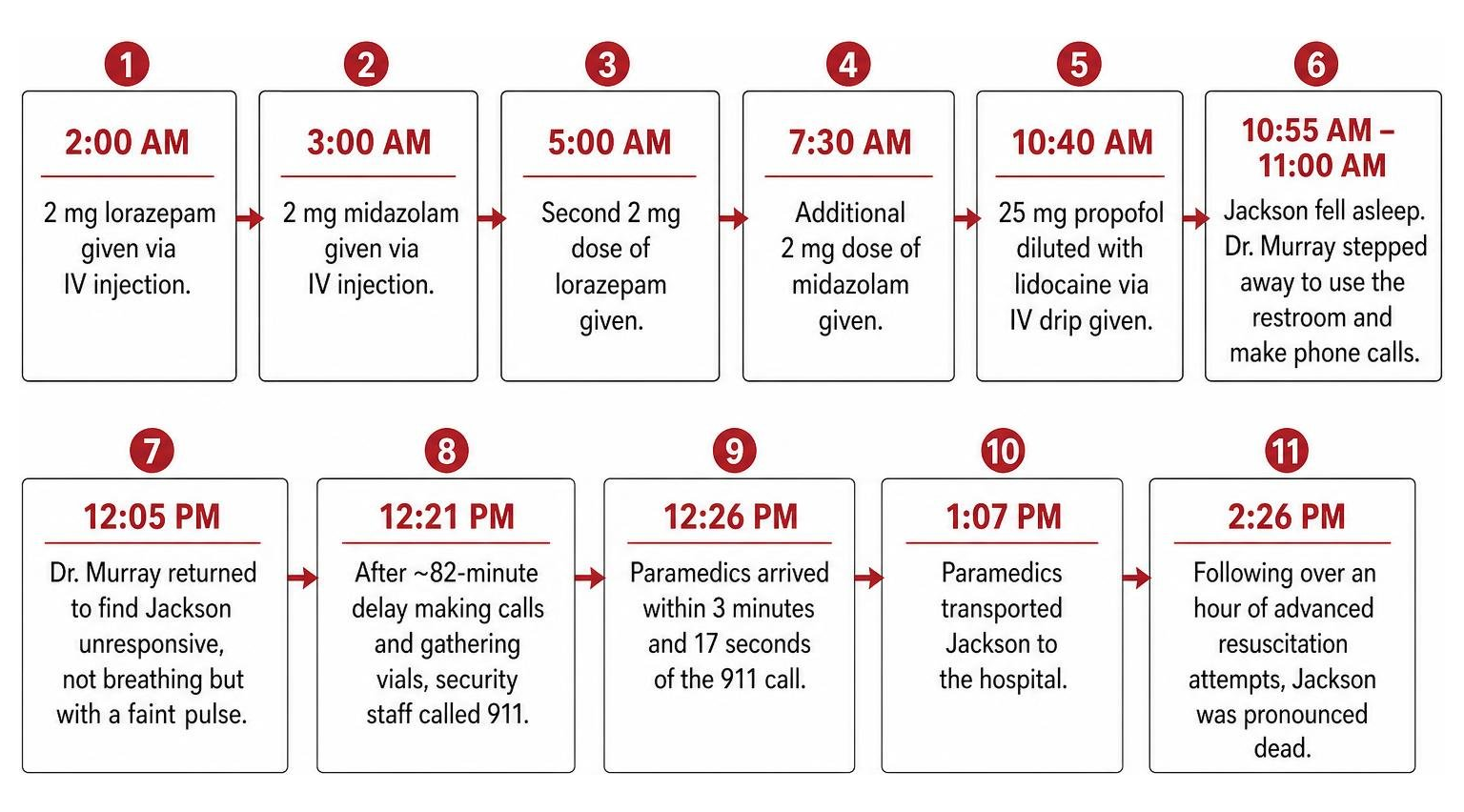
The sequence of medical events on the morning of June 25 unfolded across a ten-hour period:
- 1:00 AM: Jackson complained of severe exhaustion and inability to sleep. Dr. Conrad Murray administered 10 mg of Valium (diazepam).
- 2:00 AM: Unable to sleep, Jackson was given 2 mg of lorazepam via intravenous injection.
- 3:00 AM: Jackson remained wide awake. Dr. Murray administered 2 mg of midazolam IV.
- 5:00 AM: Dr. Murray administered a second 2 mg dose of lorazepam.
- 7:30 AM: Jackson received an additional 2 mg dose of midazolam.
- 10:40 AM: After repeated pleas from Jackson for his “milk,” Dr. Murray administered 25 mg of propofol diluted with lidocaine via an IV drip.
- 10:55 AM – 11:00 AM: Jackson fell asleep. Dr. Murray claimed he stepped away to use the restroom and make personal phone calls.
- 12:05 PM: Dr. Murray returned to the bedroom to find Jackson unresponsive, with stopped breathing but a faint pulse.
- 12:21 PM: After a nearly 82-minute delay spent making phone calls and gathering medical vials, security staff finally dialed 911.
- 12:26 PM: Los Angeles Fire Department paramedics arrived within 3 minutes and 17 seconds of the 911 call.
- 1:07 PM: Paramedics transported Jackson to Ronald Reagan UCLA Medical Center.
- 2:26 PM: Following over an hour of advanced resuscitation attempts, physicians officially pronounced Michael Jackson dead.
For a detailed chronological breakdown, historians often refer to the comprehensive Timeline of the death of Michael Jackson.
Why Was Michael Jackson Taking Powerful Sedatives?
Why was the King of Pop resorting to general surgical anesthetics in a residential bedroom? The root cause was severe, long-standing chronic insomnia, aggravated by extreme physical and mental stress.
Jackson was preparing for a grueling schedule of 50 concerts. His physical demands were enormous, and sleeplessness had haunted him for decades. Former medical professionals, including holistic nurse practitioner Cherilyn Lee, testified that Jackson had asked for propofol as early as April and May 2009. Lee refused, warning him that using an anesthetic to sleep was dangerous and could prevent his body from waking up.
During his 1996–1997 HIStory world tour, private doctors had reportedly used intravenous sleep aids to knock Jackson out overnight and wake him up in the morning. Believing propofol was a safe miracle cure for his sleep deprivation, Jackson actively sought physicians willing to administer it.
Emergency Response and Resuscitation Errors
The emergency response at the Holmby Hills mansion was marked by critical delays and fundamental basic care errors.
When Dr. Murray discovered Jackson unresponsive, he attempted chest compressions. However, he performed CPR with one hand while Jackson lay on a soft mattress rather than placing him flat on a hard, solid floor. CPR performed on a soft bed dissipates the force of the compressions, rendering resuscitation efforts largely useless.
Furthermore, Dr. Murray did not instruct security to call emergency services immediately. Instead, approximately 82 minutes elapsed between the discovery of Jackson’s condition and the call to 911. As early reports noted when Michael Jackson dead at 50 after cardiac arrest – CNN.com was published, paramedics arrived quickly at 12:26 PM, but Jackson was already in full cardiac arrest with an absence of brain activity.
Dr. Conrad Murray: Medical Malpractice and Conviction
The central legal figure in the death of Michael Jackson was Dr. Conrad Robert Murray, a cardiologist hired in May 2009 to serve as Jackson’s personal physician for the This Is It tour. AEG Live had agreed to pay Murray $150,000 per month (equivalent to roughly $225,000 today) to manage Jackson’s physical health.

Following the coroner’s homicide declaration, the LAPD and the Drug Enforcement Administration (DEA) launched a joint investigation. This eventually led to criminal charges against Murray for gross negligence and medical failure, details of which are preserved in the legal history of the Death of Michael Jackson.
Standard of Care Violations
During the prosecution, medical experts testified that Dr. Murray committed numerous fundamental violations of the medical standard of care:
- Inappropriate Medical Environment: Administering propofol inside a private home bedroom lacking emergency medical infrastructure.
- Lack of Monitoring Equipment: Failing to use continuous capnography, pulse oximetry, blood pressure monitors, or automated heart alarms.
- Absence of Emergency Gear: Administering anesthetics without an airway management setup, continuous oxygen supply, or crash cart.
- Patient Abandonment: Leaving the sedated patient unmonitored to handle private phone calls and emails.
- Delayed Emergency Response: Waiting nearly an hour and a half before notifying professional emergency personnel.
The Criminal Trial, Verdict, and Sentence
Dr. Murray’s criminal trial began in September 2011 in Los Angeles. The defense argued that Jackson had self-administered the fatal dose of propofol while Murray was out of the room. However, prosecution toxicologists demonstrated that Jackson could not have physically ingested or self-injected the medication to reach the measured blood levels given his state of sedation.
On November 7, 2011, the jury unanimously found Dr. Conrad Murray guilty of involuntary manslaughter. Judge Michael Pastor sentenced Murray to the maximum allowed term of four years in county jail, citing a “systematic pattern of deceit and lies.”
Due to California prison overcrowding policies under AB 109 state realignment, Murray served one year and eleven months before being paroled in October 2013. His medical licenses in California, Texas, and Nevada were permanently revoked or suspended.
Cultural Impact and Media Reaction
The announcement of Michael Jackson’s death triggered an unprecedented wave of global grief and digital activity. When the news broke on the afternoon of June 25, 2009, major online services experienced historically high traffic spikes:
- Google: Misinterpreted the vast volume of searches for “Michael Jackson” as a distributed denial-of-service (DDoS) attack, resulting in search service blockages for 25 minutes.
- Wikipedia: Recorded nearly 1 million user visits to Jackson’s biography within an hour, causing temporary server crashes.
- Twitter and News Outlets: Twitter, AOL Instant Messenger, and major news portals suffered widespread outages as millions shared the news simultaneously.
As detailed by reporting on how Michael Jackson, King of Pop, is dead at 50 – Los Angeles Times, spontaneous public gatherings erupted globally, from Times Square in New York City to Tokyo, London, and Paris.
On July 7, 2009, a public memorial service was held at the Staples Center in Los Angeles. Over 1.6 billion people registered for the free ticket lottery, and an estimated global television and online audience of 2.5 billion viewers tuned in, making it one of the most-watched live broadcasts in history.
In the commercial sphere, Jackson became the best-selling music artist of 2009, selling over 8.2 million albums in the United States alone in the six months following his death. In 2010, Sony Music signed a record-breaking $250 million deal with the Jackson Estate to retain catalog distribution rights.
Frequently Asked Questions About How Did Michael Jackson Die
What was the official cause of Michael Jackson’s death?
The official cause of death was acute propofol intoxication, exacerbated by the sedative effects of benzodiazepines (primarily lorazepam and midazolam). The Los Angeles County Coroner officially classified the manner of death as a homicide caused by severe medical negligence.
How did Michael Jackson die according to initial police reports?
Initial police and fire department reports indicated that Michael Jackson suffered sudden cardiac arrest at his rented mansion in Holmby Hills, Los Angeles. He was unresponsive when paramedics arrived, and despite extended resuscitation attempts at UCLA Medical Center, he was pronounced dead at 2:26 PM PT.
What sentence did Dr. Conrad Murray receive for his role in Michael Jackson’s death?
Dr. Conrad Murray was convicted of involuntary manslaughter in November 2011 and sentenced to the maximum term of four years in state prison. Due to California prison realignment policies aimed at easing overcrowding, he was released on parole after serving one year and eleven months.
Conclusion
Understanding how did michael jackson die reveals a tragedy born from severe chronic health struggles, extraordinary professional pressure, and a profound failure of medical ethics. The loss of the King of Pop reshaped conversations surrounding off-label prescription drug use, physician responsibility, and patient safety standards worldwide.
At Saratoga Living, we bring our readers thoughtful perspectives on culture, music history, lifestyle, and media stories that shape our world. From deep dives into iconic cultural moments to our signature coverage of the Capital Region’s sports, food, and social scenes, we are dedicated to engaging story-telling. Explore Destination Saratoga to discover more of our upscale lifestyle articles and community insights.