Photograph by Dakota Gilbert
When you trace the musical career of Jon Batiste backward from the August 2025 release of his album Big Money, to his five Grammy wins in 2022, to his 2015 appointment as the bandleader and musical director for The Late Show With Stephen Colbert, you’ll eventually find your way back to his native New Orleans, where he played his first gigs as a percussionist with his family’s band at the age of 8. But before you get there, you’ll pass through a brief yet impactful period that helped shape not only the musician Batiste would become, but the person he is today.
Founded in 1988, the Skidmore Jazz Institute each summer welcomes some 65 aspiring musicians, a majority of whom are high schoolers, to Saratoga Springs for an intensive, two-week program led by some of the country’s top jazz artists. The program was started by Don McCormack, Skidmore’s longtime dean of special programs, who took it upon himself to travel the country to recruit top talent for the program. In 2004, he found himself at Louisiana’s New Orleans Center for Creative Arts, listening to a then-16-year-old Jon Batiste play the piano.
“When you heard him play, you realized that he wasn’t playing just jazz,” McCormack remembers. “Under the jazz umbrella you can have rap, you can have soul, you can have R&B—all that has roots of jazz in it. And that was Jon. Jon could go back and forth.”
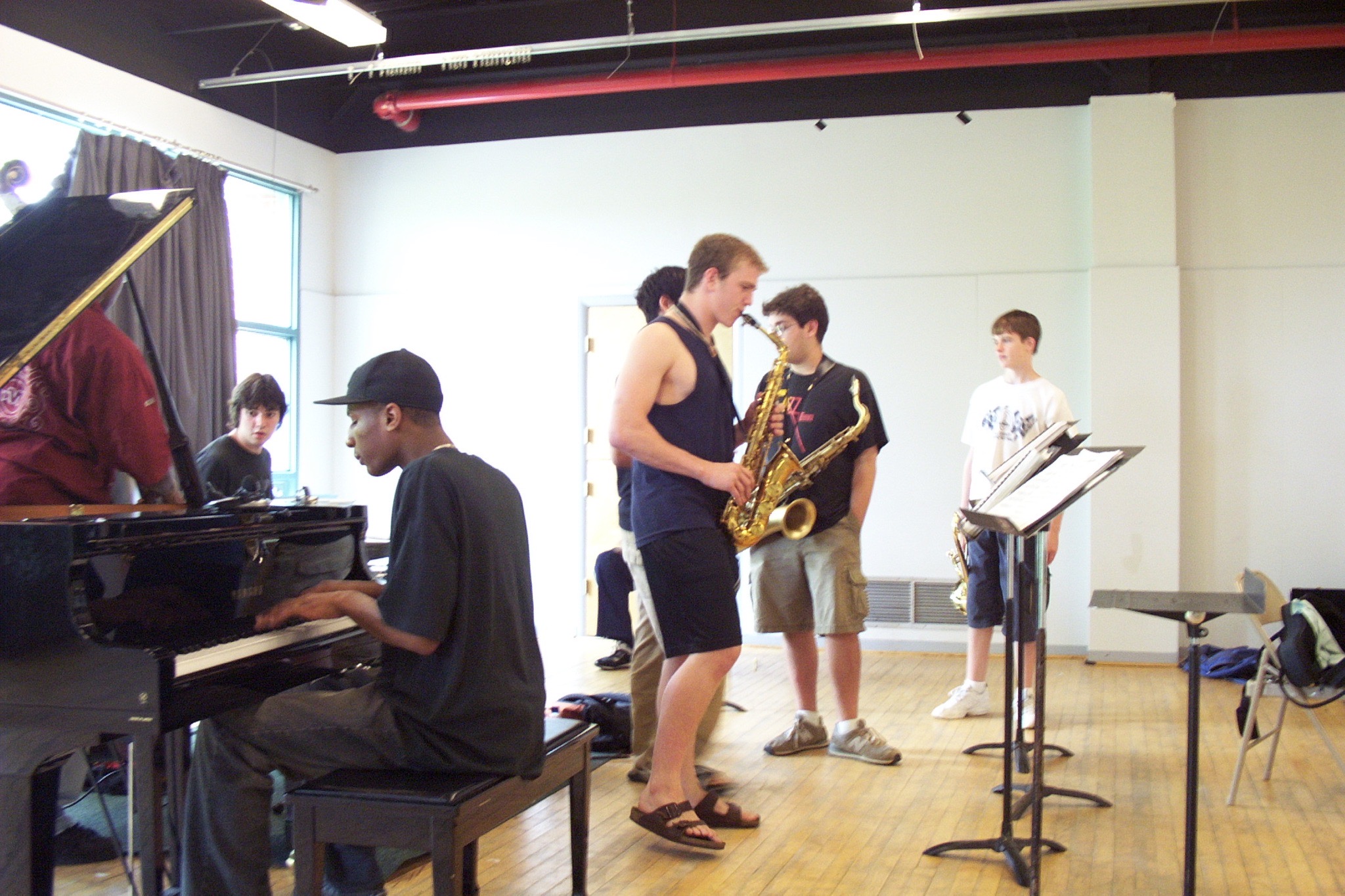
That ability to seamlessly jump genres has become a defining feature of the 2004 Jazz Institute grad’s sound, and was on full display this past August 22 at his performance with the Philadelphia Orchestra at SPAC. The show marked the release of Batiste’s newest album and the start of the 2025 Big Money Tour, and was the first time the musician had performed in Saratoga since headlining the 2018 Saratoga Jazz Festival.
“Jon Batiste’s return to SPAC this summer was more than a performance—it was a homecoming, an utter outpouring of love,” says Elizabeth Sobol, SPAC’s CEO. “To see him back on our stage, sharing his music with such joy and exuberance, and knowing that he chose to perform at SPAC on the very night his new album was released, made the evening feel all the more extraordinary.”
Big Money—with its insanely catchy title track, cover of “Lonely Avenue,” and duet with “Rise Up” singer Andra Day—is just the latest album in an ever-growing body of work that defies genre. Batiste’s last album, 2024’s Beethoven Blues, revisited the German composer’s most famous classical works; the same year, Batiste was nominated for a Grammy for his work on Lana Del Rey’s pop song, “Candy Necklace.” In the past, he’s received Grammy awards or nominations in categories including Best American Roots Performance, Best R&B Album, Best Jazz Performance, Best New Age Album, and Best Score Soundtrack for Visual Media for his work on the Pixar animated movie Soul.
If he had to categorize Big Money into a genre, Batiste himself would describe it as “New Americana”—a reframing of Americana that draws on forms of music traditionally left out of the genre but that are undoubtedly a part of the sound of America itself.

“There is no such thing as genre—it’s just what you, as the artist, are into at this moment in time,” Batiste says. “What is it that is inspiring you? You’ll realize that you are so multifaceted and that we all have so much within us that it’s impossible to categorize people. I can only categorize a person by calling them the genre of themself.”
At press time, 2026 Grammy nominations had yet to be announced, though Variety included Big Money in its list of predictions for Album of the Year nominees. But Batiste, who’d been touring the country since his SPAC show and still had performances in Europe and Asia left on the calendar, was already thinking two steps ahead.
“When you come to see the tour, you are witnessing the next album being created live on stage,” he says. “I didn’t realize how much playing this music live would inspire the next chapter so quickly. This is not a concert—this is a spiritual practice. Because that’s what our shows are: a celebration of life, a revival.”
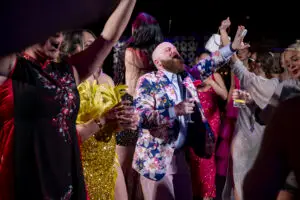
If you’ve ever seen Batiste perform, live or on a screen, you know this. All of his performances seem like celebrations, with many, including his August show at SPAC, ending in a New Orleans–style second line parade out of the venue led by Batiste on melodica, a cross between a harmonica and a keyboard. “At the end of the performance, people were going to him—they wanted to touch him,” McCormack says of the recent SPAC show. “They wanted to feel his freakin’ soul.”
No one can deny that Batiste’s exuberance is infectious; fellow Louisiana-born singer Lauren Daigle once described him as “the personification of joy”—a characterization made all the more meaningful given what’s going on in his personal life.
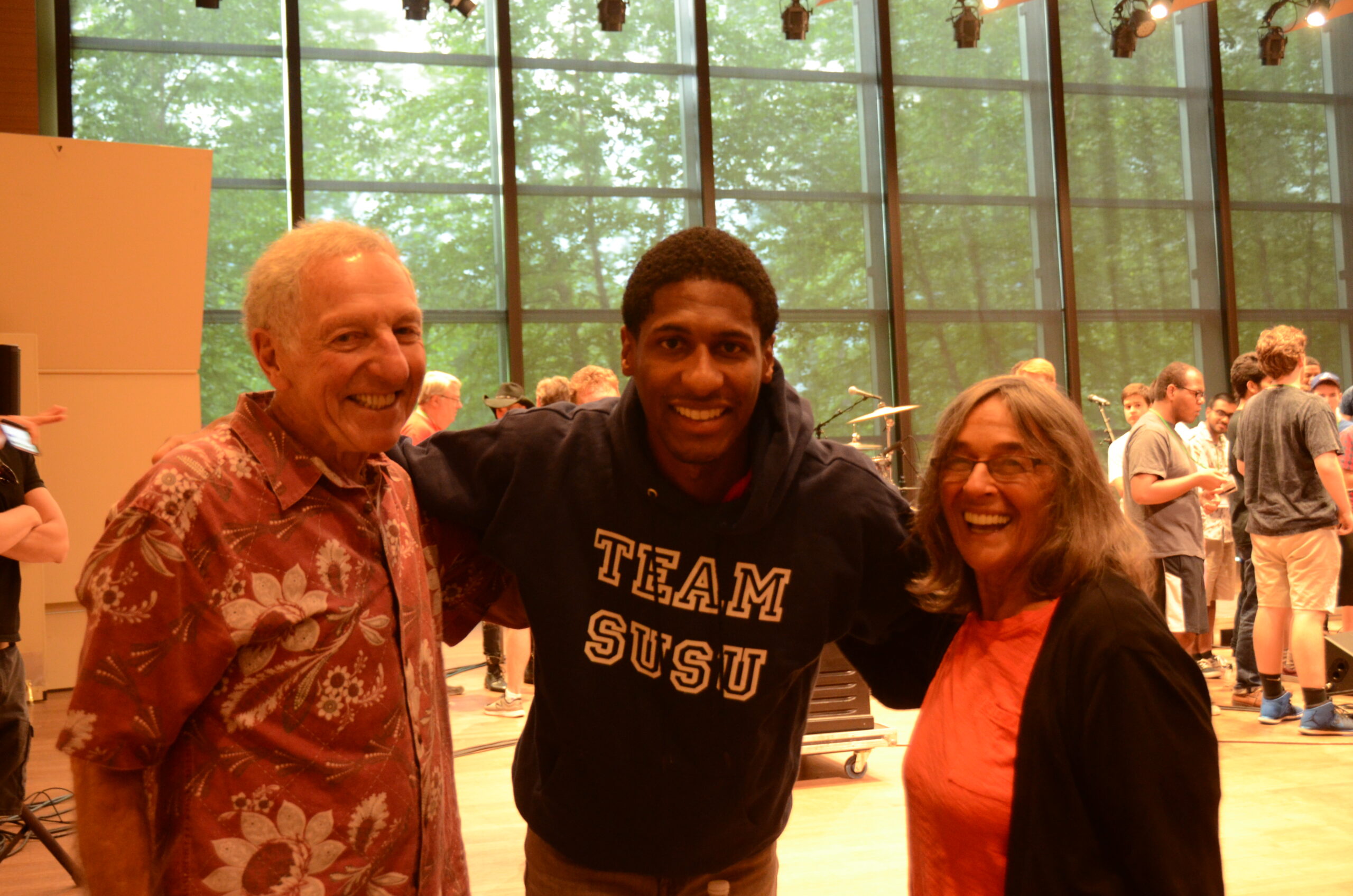
It doesn’t make sense to talk about Batiste’s illustrious career—which in recent years has brought him to the Met Gala, the White House State Dinner, and the Super Bowl—without talking about his relationship with his wife, writer Suleika Jaouad, and her relationship with hospital beds.
“A lot of people who are still in my life and who are major parts of my life I met at Skidmore,” Batiste says, referencing not only Joe Saylor and Philip Kuehn, fellow Jazz Institute grads with whom he formed the band Stay Human, the house band for The Late Show, but also Jaouad, who didn’t attend the Institute but whose father was a French professor at Skidmore. “I thought Suleika was a brilliant, bohemian wild child,” Batiste says. “She wore sandals in the woods and played the double bass.”
At the age of 22—years after after meeting Batiste but before the couple started dating—Jaouad was diagnosed with leukemia. Shortly after, she began writing a widely read New York Times column and video series titled “Life, Interrupted” from her hospital bed. She went on to document her healing journey in a best-selling book, Between Two Kingdoms, which was released in February of 2021. Later that year, her cancer returned. On Jaouad’s first day of chemotherapy, Batiste, who by that point had become her boyfriend, was nominated for 11 Grammy Awards.
“I feel like we’re living a life of contrasts,” Jaouad says in American Symphony, the Grammy-winning 2023 Netflix documentary that follows the couple as Batiste sets out to compose an original symphony while Jaouad undergoes cancer treatment.
“I win the biggest prize in music, come home, she’s back in the hospital,” Batiste says in the film. “This is what we’re dealing with.”

The documentary, which features the couple’s private wedding, ends with Batiste unveiling his symphonic masterpiece at Carnegie Hall, despite a brief power outage that cut sound to the orchestra. (Naturally, Batiste improvised on the piano until power was restored.) Meanwhile, Jaouad’s battle with cancer was far from over; it returned yet again in 2024. In a video posted to Jaouad’s Instagram this summer, Batiste, desperate to do something—anything—to ease his wife’s chemo-induced nausea, serenades her from the piano in the corner of their bedroom.
“Joy often comes from pain,” Batiste says when I ask him about how he maintains his legendary positivity in the face of hardships in his personal life. “Joy is often powerful because it comes after the rain. The beauty of life is that we are all alive and breathing with another chance to do God’s will, to love our neighbor, to enjoy our work. All we need is what we have; our soul is what will last. This is a belief that allows for me to always tap into the joy of living.”
Throughout Batiste’s career, Saratoga Springs has remained one such source of joy. “I loved Saratoga,” he says, thinking back to his first visit to the city as a teenager. “At the time, I’d never really traveled much outside of New Orleans. It felt very Zen and somehow kindred to some of the suburbs in southeast Louisiana. Every time I visit, it feels like a second home to me.” And in a way, it is. Jaouad’s parents still live in Saratoga, so the couple comes up to visit with them “mostly during the Christmas holiday,” Batiste says. “It’s quite a joy to be in Saratoga during the winter.”

In talking with Batiste, it’s clear that while his time at the Skidmore Jazz Institute certainly helped launch his career in music, Saratoga is and will always be, first and foremost, the place where he met Jaouad. He counts their marriage as his biggest accomplishment to date, and says that his approach to music, oftentimes, is just trying to make an album that she will like.
“That’s Jon,” says McCormack, who still occasionally stays in touch with Batiste and hopes to one day have him as a McCormack Visiting Artist-Scholar in Residence at Skidmore. “He has so much feeling. He’s such a special person. The whole world knows that, and that’s why people want to see him.”
Indeed, Batiste seems to exude an unfettered love for humanity—a sense of unity that’s ever-present in his music and that was palpable when he took the SPAC stage this past summer.
“I like to say, ‘I love ya even if I don’t know ya,’” he says. “You are not alone in what you’re going through. Someone has been through it before, or they are going through it right now and will overcome. Try to stay focused on each step, one at a time. Be present and trust that everything occurring is working together to strengthen you in your path.”
And what a beautiful path it is.