It was the promise of a Girl Scout patch that first introduced Moira D’Andrea—now three-time Olympian Moira D’Andrea Marshall—to the sport that would define her teenage and adult years.
Born to a large, tight-knit family in Saratoga Springs, D’Andrea Marshall grew up across from Saratoga Hospital on Church Street. Her father, Joseph, ran the restaurant D’Andrea’s on Broadway, and her mother, Mary Ellen, was a homemaker who led her daughter’s Girl Scout troop. When she saw an ad in the newspaper advertising free speed skating lessons at the Saratoga Winter Club, Mary Ellen signed the girls up. “We went because you could earn a skating patch,” says D’Andrea Marshall, who showed up to the rink with speed skates her family had procured from a neighbor’s garage sale. “After that lesson, they invited me to come to a real club practice, mostly because I’d brought speed skates with me.”
Whether it was the second-hand speed skates or the fact that the 8-year-old showed real promise on the ice, the coaches at Saratoga Winter Club made the right choice in inviting D’Andrea Marshall back. She fell in love with the sport immediately, and by age 14, was competing internationally, primarily as a long track speed skater, but occasionally on the short track as well. It was the Winter Club—an organization that since 1934 has produced more than a dozen Olympians including John Wurster, Pat Maxwell, Kristen Talbot, Dave Tamburrino, and 2010 men’s team pursuit silver medalist Trevor Marsicano—that proved to D’Andrea Marshall what was possible.
“You could see a direct pathway to becoming an elite skater, because there were so many people involved with the club that had been Olympians,” she says. Add in the fact that she was learning to skate less than two hours away from Lake Placid—where US speed skater Eric Heiden won an unprecedented five gold medals in the 1980 Olympics—and the possibility of being an Olympian seemed attainable.
Indeed, as the 1988 games in Calgary approached, D’Andrea Marshall was a genuine contender for one of the coveted Team USA spots. Though she’d been training primarily as a long track skater, a short track opportunity knocked close to home. In February 1987, she participated in the short track speed skating Olympic trials, which were held in nearby Troy, and made the team as an alternate. (She tried out unsuccessfully for the long track team in December of ’87.) In the Calgary Games, she raced in a short track relay event for Team USA. At the time, short track was a demonstration sport.
Just 20 at the time of the ’88 Games, D’Andrea Marshall seemed poised to take the speed skating track by storm four years later. But as she prepared for the 1992 Winter Games in Albertville, France, she was severely injured in a car crash that kept her out of training for six months. Despite the setback, she made the American team for the ’92 games and finished 32nd in the 1000 meters.
In the years that followed, D’Andrea Marshall enjoyed her greatest international success, earning bronze medals in the 500 meters at both the 1995 and 1996 Speed Skating World Championships. And then, disaster struck again.
Shortly after the ’96 World Championships, D’Andrea Marshall was struck by a car while training on her bicycle. She broke her pelvis in three places and severed a tricep. Again, her career seemed to be over. Again, she persevered through rehab and recovery.
“I tried to imagine myself skating when I couldn’t skate,” she says. “I worked on my technique in my head. If you’re doing something in your mind, your body doesn’t really know that you’re not doing it. You can correct technique by doing it properly in your head before you can physically do it.”
That method proved effective. In the 1998 Nagano Games, D’Andrea Marshall enjoyed the best finishes of her Olympic career: ninth in the 1000 meters, 14th in the 1500 meters, and 19th in the 500 meters. Only then did she retire from international competition—on her own terms.
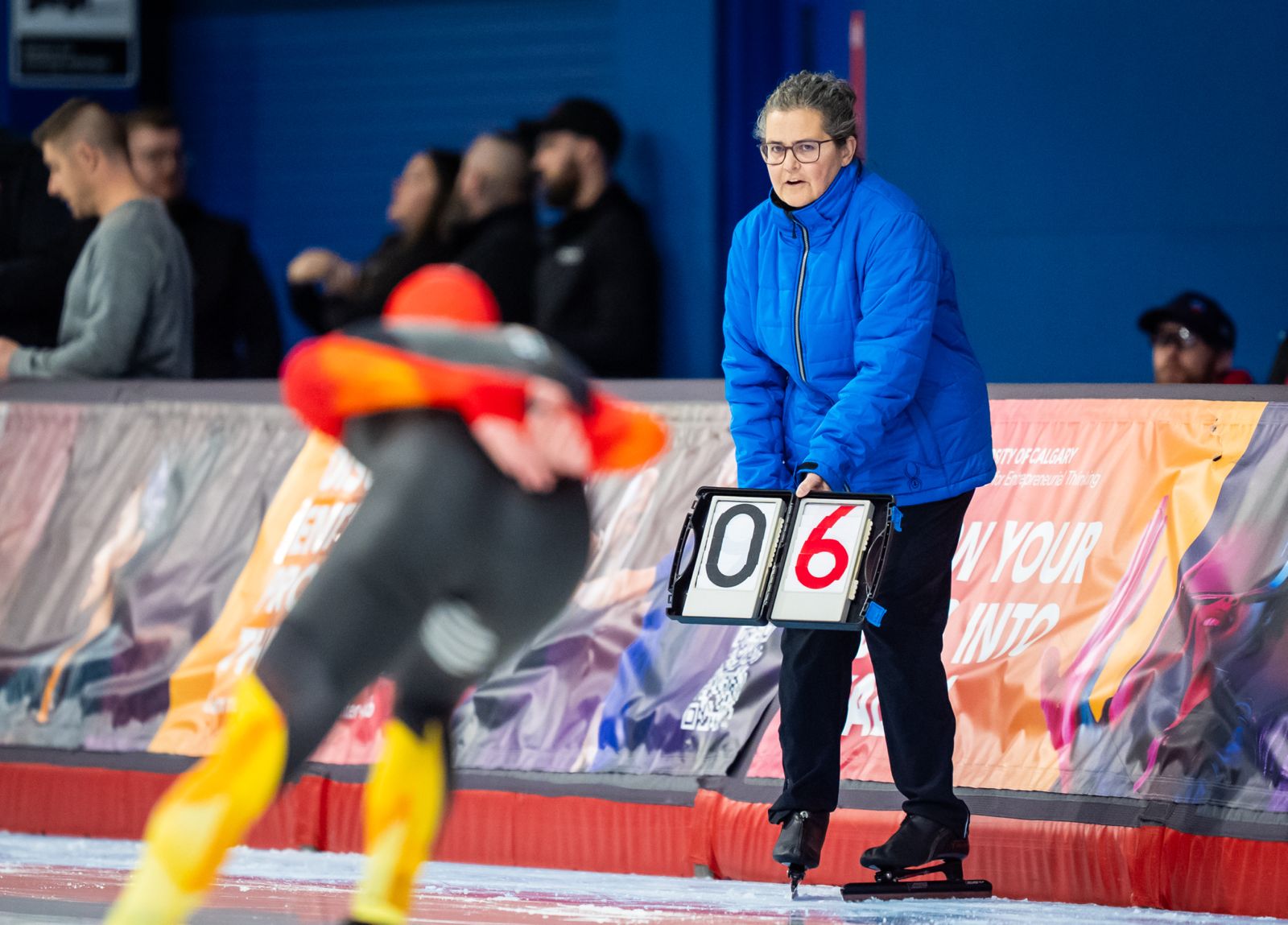
But D’Andrea Marshall didn’t leave the sport that had shaped most of her life. In 2002, the Saratoga native coached the Canadian national long track speed skating team at the Salt Lake City Olympics, and for close to a quarter century has been one of Canada’s top speed skating coaches. In 2015, she was inducted into the United States Speed Skating Hall of Fame. She now lives in Calgary with her husband, Canadian speed skater Mike Marshall, with whom she has three children. She spends her mornings working as a teacher’s aide, and her afternoons coaching speed skating for a Calgary-area club team and the provincial Speed Skating Alberta.
“I have a lot of experience that I can share with them,” D’Andrea Marshall says of the young skaters she coaches. “I bring a bit of calmness when they’re not doing well.” As much as anything, she tries to impart the wisdom she received from her many great coaches—starting all those years ago at the Saratoga Winter Club.