Naomi Osaka: A Champion Whose Impact Reaches Beyond Tennis
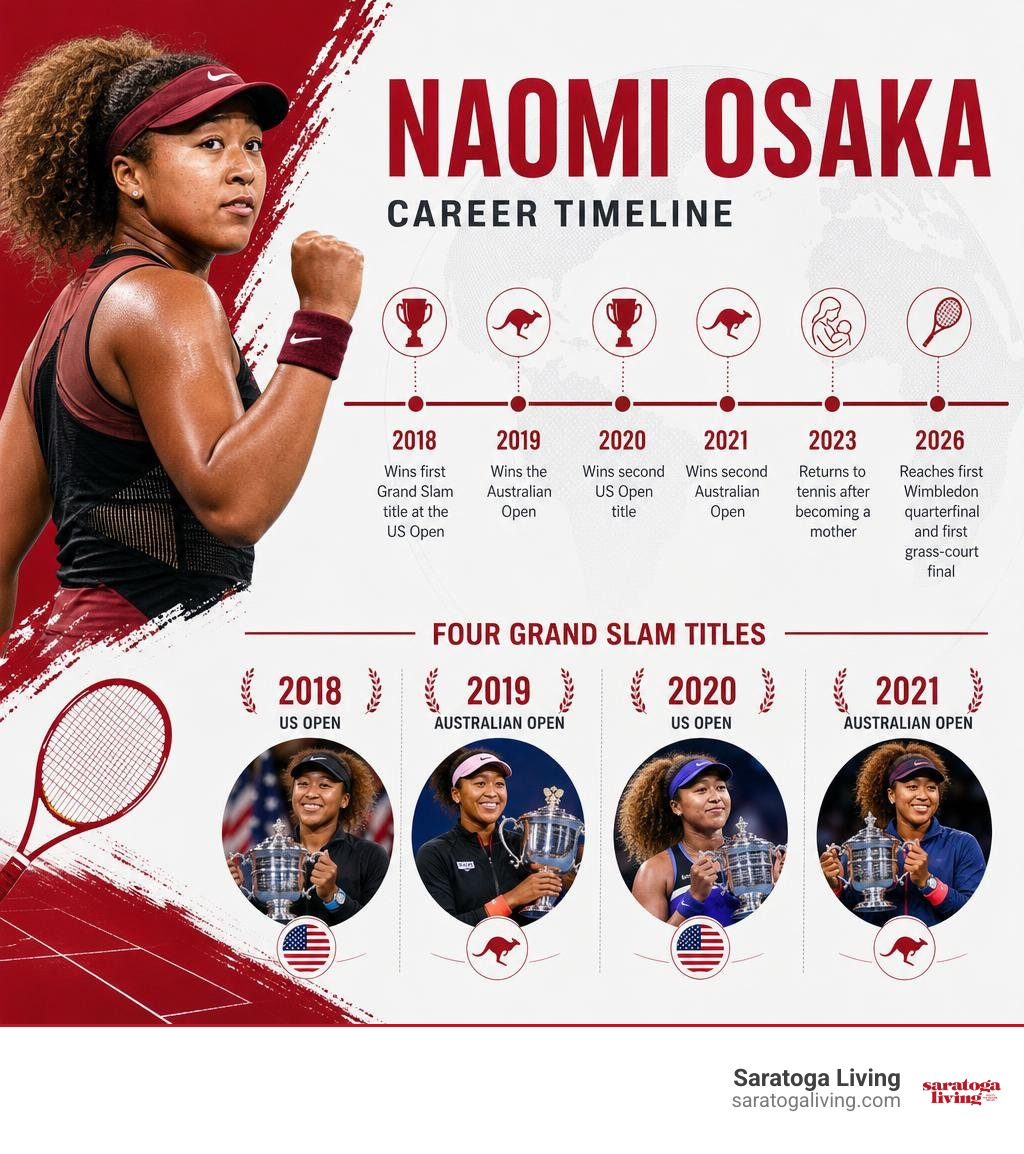
Naomi Osaka is a Japanese professional tennis player, four-time Grand Slam singles champion, former world No. 1, and one of modern sport’s most influential voices. She has won the US Open twice (2018 and 2020) and the Australian Open twice (2019 and 2021), becoming the first Asian player to hold the top WTA singles ranking.
Her story is bigger than trophies. Osaka has spoken openly about mental health, used major stages to call attention to racial injustice, and returned to elite tennis after becoming a mother in 2023. In 2026, she reached her first Wimbledon quarterfinal and her first grass-court final, confirming that her comeback remains one of tennis’s most compelling stories.
Born in Osaka, Japan, to a Japanese mother and Haitian father, Osaka grew up in the United States but chose to represent Japan. Her powerful serve, calm baseline game, and willingness to set boundaries have helped redefine what a global athlete can be.
This A-Z guide looks at her career, family roots, advocacy, business influence, and 2026 resurgence. Guest Posts will guide you through the milestones that made Osaka a defining athlete of her generation.
Naomi osaka terms to know:
Early Life, Multicultural Roots, and Unconventional Training
Naomi Osaka was born on October 16, 1997, in Chūō-ku, Osaka, Japan. Her multicultural background brings together two distinct heritage paths: her mother, Tamaki Osaka, hails from Nemuro on the northern Japanese island of Hokkaido, while her father, Leonard François, was born in Jacmel, Haiti. When Naomi was three years old, the family relocated from Japan to Long Island, New York, living with her maternal grandparents before eventually moving south to Pembroke Pines, Florida, to support full-time athletic development.
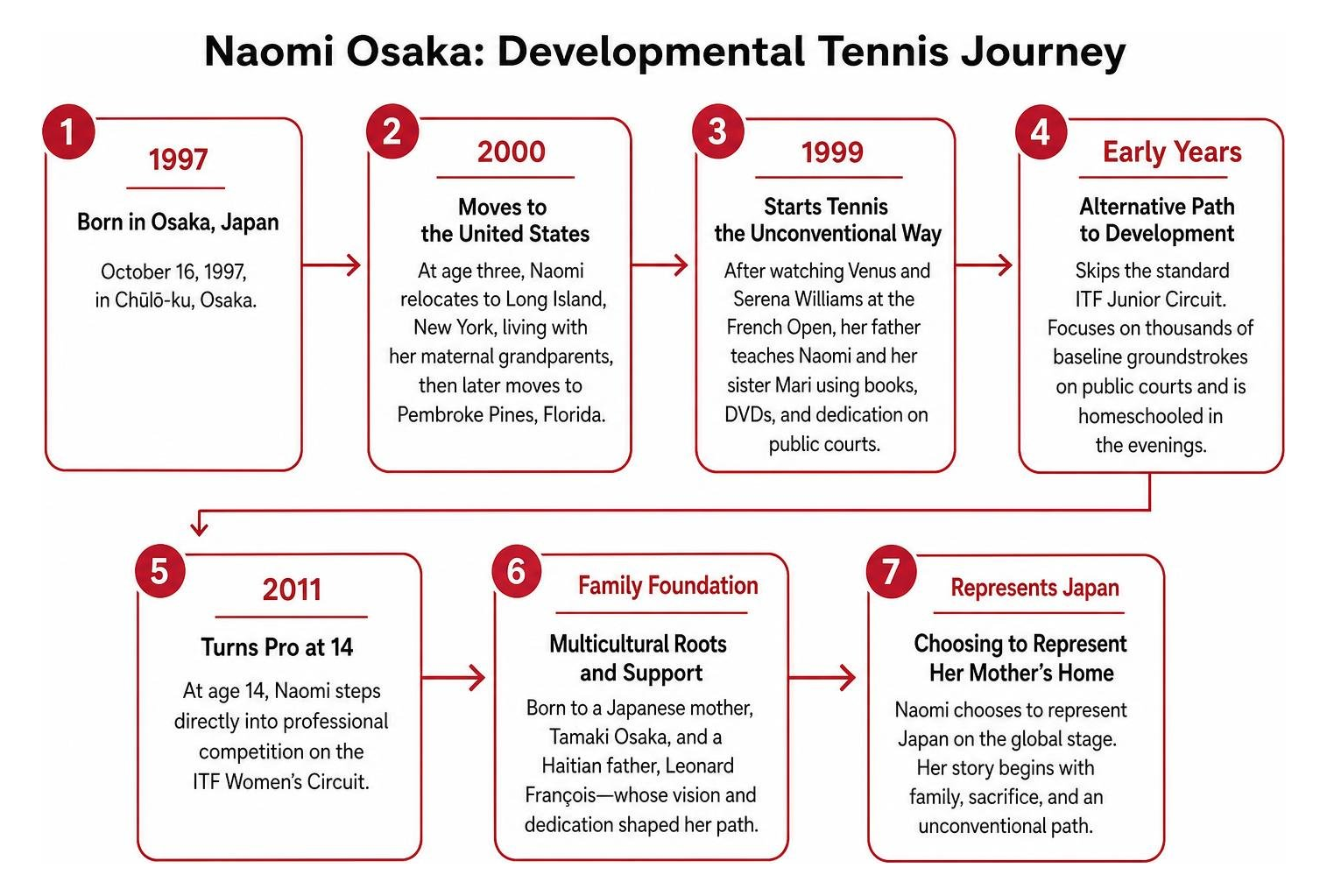
Her introduction to tennis was distinctly unconventional. In 1999, after watching Venus and Serena Williams dominate the French Open, Leonard François was inspired by Richard Williams’ unorthodox blueprint. Despite having no personal background as a competitive tennis player, François decided he would teach his two daughters, Mari and Naomi, the sport from scratch. Armed with instructional books, instructional DVDs, and relentless determination, he spent hours running drills with the girls on local public courts across Long Island and South Florida.
To focus entirely on skill acquisition and physical conditioning, the family chose an alternative path: Osaka skipped the standard ITF Junior Circuit almost entirely. Instead of traveling the international junior circuit chasing ranking points, she spent her days hitting thousands of baseline groundstrokes on public courts and was homeschooled in the evenings. By age 14 in 2011, she stepped directly into professional competition on the ITF Women’s Circuit. For more on her upbringing and lineage, fans can explore All About Naomi Osaka’s Family: Meet Her Parents, Sister, and Daughter to see how those early years shaped her trajectory.
Family Foundation and Deciding to Represent Japan
The sacrifices made by Naomi’s family laid the foundation for her global athletic career. During their early years in the United States, her mother Tamaki worked grueling overtime shifts in New York’s import/export industry, sometimes even catching sleep in her car between shifts to ensure her daughters had the equipment and court time they needed. Naomi frequently cited her mother’s work ethic as a primary motivation, determined to succeed so her mother could finally rest.
Mari Osaka, older than Naomi by eighteen months, served as her constant practice partner and early rival. Naomi famously noted that it took twelve years of training before she managed to win a single practice match against Mari. Mari went on to play professional tennis herself before retiring in 2021 to pursue artistic design and fashion.
Although raised and trained predominantly in the United States, Osaka has represented Japan throughout her entire professional career. Her parents registered both sisters with the Japan Tennis Association (JTA) early in their development. The choice reflected their cultural upbringing—raised with Japanese values and cuisine—as well as early logistical support from the Japanese tennis federation. Osaka has spoken proudly of her multi-ethnic identity, representing a modern, multicultural generation across Japan, Haiti, and the United States.
The Rise and Dominance of Naomi Osaka on the Global Stage
Osaka first caught the tennis world’s attention in July 2014 during her WTA main-draw debut at the Bank of the West Classic in Stanford. Entering as a 16-year-old qualifying alternate ranked No. 406, she faced world No. 19 and former US Open champion Samantha Stosur. In a dramatic display of raw power, Osaka saved a match point and overcame a 5–3 deficit in the third set to pull off a monumental upset.
Her steady ascent continued over the next two seasons. In 2016, after reaching the third round of three Grand Slams and contesting her first WTA final in Tokyo, she was voted the WTA Newcomer of the Year. Osaka’s game was anchored by one of the heaviest serves in the sport—consistently clocked above 190 km/h and peaking at 201 km/h (125 mph)—pairing effortless service velocity with explosive, flat groundstrokes off both wings.
Her true top-flight breakthrough arrived in March 2018 at the BNP Paribas Open in Indian Wells. Unseeded and ranked No. 44, she dispatched Maria Sharapova, Karolína Plíšková, and world No. 1 Simona Halep en route to hoisting her maiden WTA title. Working alongside high-level tacticians—and later teaming up with premier coaches including Tomasz Wiktorowski—Osaka refined her aggressive shot-making with superior court positioning and point construction. For comprehensive performance records and tracking, review the Naomi Osaka | Player Stats & More – WTA Official profile.
Grand Slam Masterclasses: US Open and Australian Open Triumphs
Between late 2018 and early 2021, Osaka established an era of hard-court dominance, capturing four Grand Slam titles in three and a half years. Notably, she became only the third player in the Open Era—alongside Monica Seles and Roger Federer—to win each of the first four Grand Slam singles finals she contested.
- 2018 US Open: Osaka marched into the final in Flushing Meadows to face her childhood idol, Serena Williams. Playing composed, aggressive tennis, Osaka won 6-2, 6-4 to become the first Japanese player to capture a Grand Slam singles crown.
- 2019 Australian Open: Osaka backed up her New York triumph in Melbourne, surviving a three-set thriller against Petra Kvitová (7-6, 5-7, 6-4). With the victory, she climbed to World No. 1 on January 28, 2019, making history as the first Asian player to hold the singles top ranking.
- 2020 US Open: Navigating pandemic restrictions, Osaka reached the final against Victoria Azarenka. After dropping the opening set and trailing by a break in the second, Osaka altered her tactics, cutting down unforced errors to orchestrate a 1-6, 6-3, 6-3 comeback victory.
- 2021 Australian Open: Osaka displayed supreme hard-court authority, saving two match points against Garbiñe Muguruza in the fourth round before sweeping Jennifer Brady in straight sets in the final to lift her fourth major trophy.
Beyond Tennis: Mental Health Advocacy, Activism, and Global Influence

Osaka’s cultural footprint extends far past the baseline. During the height of the social justice movements in the summer of 2020, she used her platform to spotlight victims of racial injustice. At the 2020 US Open, Osaka arrived on court for each of the seven rounds wearing a different face mask bearing the name of an African American individual killed by violence—including Breonna Taylor, Elijah McClain, Trayvon Martin, and George Floyd. When asked after the final what message she hoped to send, Osaka replied simply: “The point is to get people to start talking.”
Her global prominence was cemented on the ultimate international stage in July 2021, when she was selected to light the Olympic cauldron at the Tokyo 2020 Olympic Games opening ceremony, becoming the first tennis player in history given that honor.
Off the court, Osaka has built an expansive business ecosystem:
- Hana Kuma: A media production company founded in partnership with SpringHill Company, producing culturally diverse storytelling and documentaries.
- KINLÒ: A sun-care and skincare line specifically formulated to protect and nourish melanin-rich skin tones.
- Fashion & Collaborations: A regular attendee of the Met Gala (which she co-chaired in 2021 in a custom Louis Vuitton gown co-designed by her sister Mari), Osaka has designed capsule collections with ADEAM and Nike.
Her commercial appeal transformed sports business economics. In 2020, Forbes reported that Osaka earned $37.4 million in a single calendar year ($34 million from endorsements), breaking Maria Sharapova’s single-year earnings record and making Osaka the highest-paid female athlete in sports history. Readers can explore her business ventures and personal statements at About | Naomi Osaka.
How Naomi Osaka Revolutionized Athlete Mental Health Advocacy
In May 2021, Osaka initiated a worldwide conversation about athlete well-being during the French Open. Announcing on social media that she would not participate in mandatory post-match press conferences to protect her mental health against anxiety and depression, she faced fines and tournament warnings. In response, Osaka withdrew from the tournament entirely, explaining her long-standing battles with depressive episodes following high-pressure competitions.
Her vulnerability triggered widespread re-evaluations across international sporting governing bodies. Major sports leagues, including the WTA, Grand Slam committees, and Olympic federations, expanded mental health resources, hired on-site sports psychologists, and reassessed post-match press protocols. Osaka demonstrated that setting boundaries is an essential component of long-term athlete performance.
The Comeback: Motherhood and the 2025–2026 Tour Resurgence
In September 2022, Osaka stepped away from professional tennis, later announcing she was expecting her first child with her partner, the Grammy-nominated artist Cordae. In July 2023, Osaka gave birth to their daughter, Shai.
Determined to show her daughter what competitive dedication looks like, Osaka returned to the WTA Tour at the start of the 2024 season. Rebuilding footwork, core strength, and timing after a 15-month hiatus, her comeback gained significant momentum in 2025:
- Captured her first title as a mother at the WTA 125 Saint-Malo, defeating Kaja Juvan in the final.
- Reached the final of the WTA 1000 Canadian Open.
- Advanced to the semifinals of the 2025 US Open, propelling her back into the WTA top 15 (reaching No. 14 in September 2025).
Fans tracking her week-to-week tournament progress can find scores and match insights on the Naomi Osaka Stats, News, Pictures, Bio, Videos – ESPN hub.
Naomi Osaka in 2026: Resurgence, Grass-Court Milestones, and Beyond
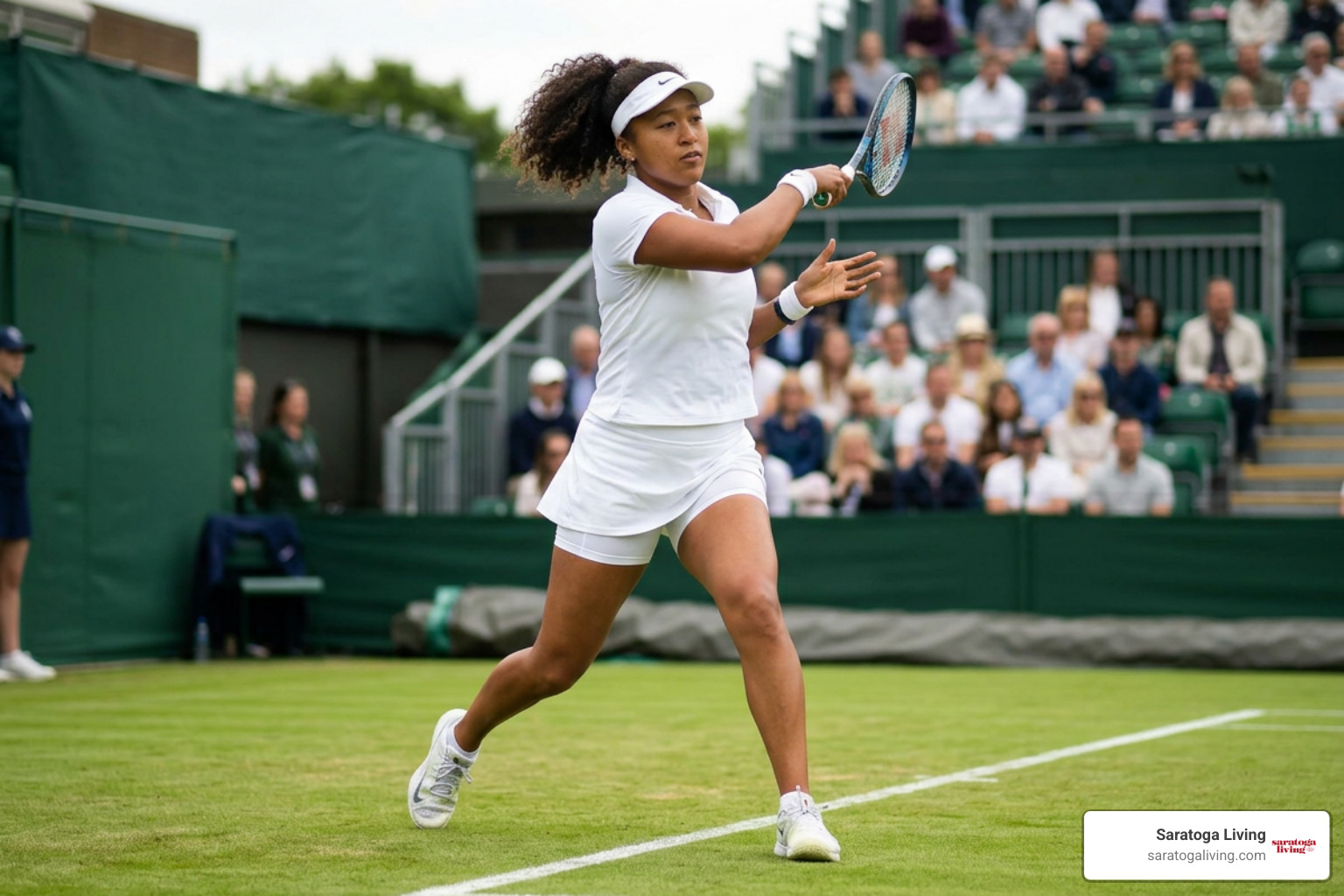
The 2026 season has witnessed Osaka expanding her versatility beyond hard courts. Long known as a hard-court specialist, Osaka made technical adjustments to her movement on grass, shortening her backswings and staying lower through contact.
At the 2026 Wimbledon Championships, Osaka earned one of the biggest wins of her post-maternity career by defeating World No. 1 Aryna Sabalenka in straight sets (6-2, 7-6), displaying precise serving under pressure. That win carried her into her first career Wimbledon quarterfinal. Back firmly inside the top 15 at World No. 13 with over $26.6 million in career prize money, Osaka continues to compete for the sport’s biggest titles.
Frequently Asked Questions About Naomi Osaka
How many Grand Slam titles has Naomi Osaka won?
Naomi Osaka has won four Grand Slam singles titles:
- US Open: 2018, 2020
- Australian Open: 2019, 2021
She holds an undefeated 4–0 record in Grand Slam singles finals, becoming one of only three players in the Open Era alongside Roger Federer and Monica Seles to win each of their first four major finals. To read more about her encyclopedic milestones, check out the comprehensive Naomi Osaka profile.
Why does Naomi Osaka represent Japan in tennis?
Osaka was born in Osaka, Japan, to a Japanese mother and Haitian father, and moved to the United States as a child. Her parents chose to register her with the Japan Tennis Association (JTA) early in her career because the family maintained close ties to Japanese culture, language, and customs. Osaka has stated that representing Japan felt like an authentic reflection of her identity.
What is Naomi Osaka’s current ranking and career prize money?
Naomi Osaka is ranked World No. 13 in WTA singles. Over the course of her career, she has accumulated $26,612,806 in prize money across 347 singles victories, placing her 17th on the all-time WTA career earnings list. Detailed player records and weekly ranking updates are maintained on the Naomi Osaka | Player Stats & More – WTA Official directory.
Conclusion
Naomi Osaka has fundamentally broadened the definition of what an elite champion can achieve. From learning baseline groundstrokes on public Florida courts to capturing four Grand Slam titles and scaling the summit of World No. 1, her on-court achievements stand among the best of her era.
Off the court, her courage in prioritizing mental well-being and speaking out against social inequality has influenced international athletics. Whether competing on Centre Court at Wimbledon, mentoring young female athletes, or celebrating iconic sports moments and high-stakes style, Osaka demonstrates that true athletic greatness is defined by authenticity, resilience, and personal conviction.