Why Michael Landon Still Matters in Television
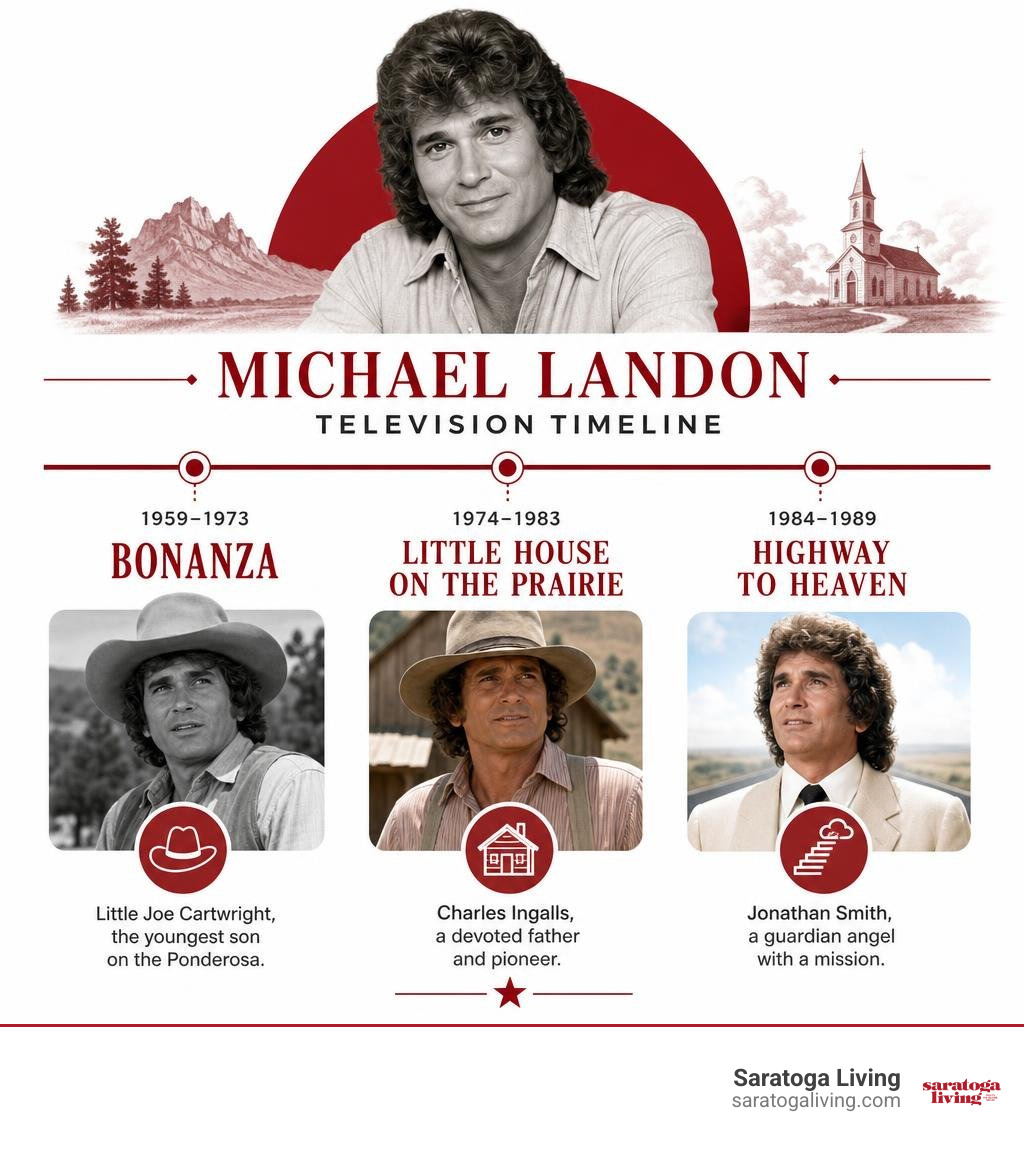
Michael Landon was an American actor, writer, director, and producer best known for three landmark TV roles: Little Joe Cartwright in Bonanza, Charles Ingalls in Little House on the Prairie, and Jonathan Smith in Highway to Heaven. Born Eugene Maurice Orowitz, he became one of television’s most enduring family-drama creators, balancing warm stories with real emotional stakes.
Across three decades, Landon helped define the idea of the TV father figure while gaining unusual control behind the camera. He appeared on the cover of TV Guide 22 times, second only to Lucille Ball, and starred in long-running hits that remain part of American pop culture.
This guide looks at the difficult childhood, athletic promise, creative drive, family life, and final public battle with pancreatic cancer behind the familiar screen image.
Guest Posts will guide you through the milestones that made Landon’s career so lasting.
Quick michael landon definitions:
Early Life, Athletics, and the Path to Stardom
Before he became a household name and prime-time fixture, Eugene Maurice Orowitz navigated a tumultuous upbringing marked by domestic instability and personal alienation. Understanding his early years provides essential context for his later creative themes of resilience, empathy, and family devotion. Michael Landon’s early biography and roots reflect a journey defined by determination in the face of profound emotional obstacles.
Born on October 31, 1936, in Forest Hills, Queens, New York, Landon was the second child of Peggy O’Neill, an Irish Catholic dancer and comedian, and Eli Maurice Orowitz, a Jewish theatre manager and publicist. When Landon was four years old, the family relocated to Collingswood, New Jersey, a predominantly non-Jewish community at the time. This mixed-faith household created tension both within the family and in the surrounding neighborhood. Landon routinely faced anti-Semitic discrimination during his youth, including having to bicycle daily to a neighboring town to study Hebrew before celebrating his Bar Mitzvah at Temple Beth Shalom.
Eugene Maurice Orowitz and Childhood Adversity
Landon’s home life was deeply unsettled. His mother suffered from severe depression and erratic behavior, frequently making dramatic suicide attempts in front of her children. During one family beach vacation, a young Landon had to dash into the surf to rescue his mother from drowning, despite not knowing how to swim himself.
The chronic emotional strain caused Landon to struggle with severe stress-induced bedwetting into his teenage years. His mother weaponized this issue by hanging his stained bedsheets out of his bedroom window for neighbors and schoolmates to see. Landon would race home from school every afternoon to pull the sheets inside before other children could notice them. He escaped the tension by hiding in nearby wooded areas, collecting canned food in small caves, and imagining himself as a comic book hero.
These painful childhood memories became the direct inspiration for his acclaimed 1976 semi-autobiographical television film, The Loneliest Runner. Through writing and directing that project, Landon turned his private humiliation into an empathetic story that helped destigmatize bedwetting for millions of families. He also developed a deep fascination with personal strength after watching the film Samson and Delilah, letting his hair grow long in the belief that it granted him athletic endurance and physical power.
The Track Career and How Michael Landon Found Acting

Athletics served as Landon’s primary escape from domestic hardship. At Collingswood High School, he devoted himself to track and field, mastering the javelin. In 1954, Landon launched a javelin toss of 193 feet 4 inches (58.93 meters), setting the national record for the longest throw by a high school athlete in the United States that year.
His record-breaking throw earned him an athletic scholarship to the University of Southern California (USC). However, his collegiate athletic career ended abruptly. Track teammates, frustrated by Landon’s unconventional long hair, held him down and forcibly cut it off. Shaken by the incident and struggling to regain his throwing mechanics, Landon tore his shoulder ligaments shortly afterward. Unable to compete, he left USC and took various odd jobs around Southern California, including unloading freight cars and working at a service station across the street from the Warner Bros. studio lot.
While working at the gas station, Landon agreed to help an aspiring actor friend practice lines for an audition. When the casting agent saw Landon read, Landon tapped into his raw childhood memories to cry on cue with startling realism. Recognizing his screen presence, talent agent Bob Raison signed him. Because his initial choice, “Michael Lane,” was already registered with the Screen Actors Guild, Landon flipped through a Los Angeles telephone directory and chose the surname “Landon.”
His screen career launched with appearances in television anthologies and westerns, culminating in his breakout commercial role in the 1957 cult classic horror film I Was a Teenage Werewolf. The film established him as a rising star with a magnetic presence.
The Definitive Television Legacy of Michael Landon
Michael Landon’s television career spanned four decades and established an unprecedented broadcast legacy. Over a continuous 30-year partnership with NBC, he starred in, wrote, directed, and produced three of the network’s most successful family franchises. Fans and industry historians can explore Michael Landon’s filmography on TMDB to appreciate the vast scope of his on-screen and behind-the-camera credits.
| Series Title | Run Dates | Season Count | Total Episodes | Primary Character | Creative Roles |
|---|---|---|---|---|---|
| Bonanza | 1959–1973 | 14 Seasons | 430 Episodes | Little Joe Cartwright | Star, Writer, Director |
| Little House on the Prairie | 1974–1983 | 9 Seasons | 187 Episodes | Charles Ingalls | Star, Executive Producer, Writer, Director |
| Highway to Heaven | 1984–1989 | 5 Seasons | 111 Episodes | Jonathan Smith | Star, Creator, Executive Producer, Writer, Director |
Bonanza and the Breakout as Little Joe Cartwright
In 1959, at age 22, Landon was cast as Little Joe Cartwright, the youngest, quickest-tempered son on the Ponderosa Ranch in Bonanza. Broadcast in full color during an era when color television sets were still a novelty, Bonanza became an international cultural phenomenon. The show held the No. 1 spot in the Nielsen ratings for three consecutive seasons from 1964 to 1967 and ran for 14 seasons across 430 episodes.
Landon recognized that acting alone would not satisfy his creative ambitions. He began shadowing directors, studying camera angles, and observing lighting setups. He pitched his first script to executive producer David Dortort, who greenlit it, leading to Landon writing and directing numerous episodes.
Co-stars like David Canary praised Landon as “fearless” when dealing with network executives, noting his sharp eye for dramatic pacing and his instinct for humanizing characters. Landon became the youngest director in the series’ history, honing the production skills he would bring to his future projects.
Little House on the Prairie and Charles Ingalls
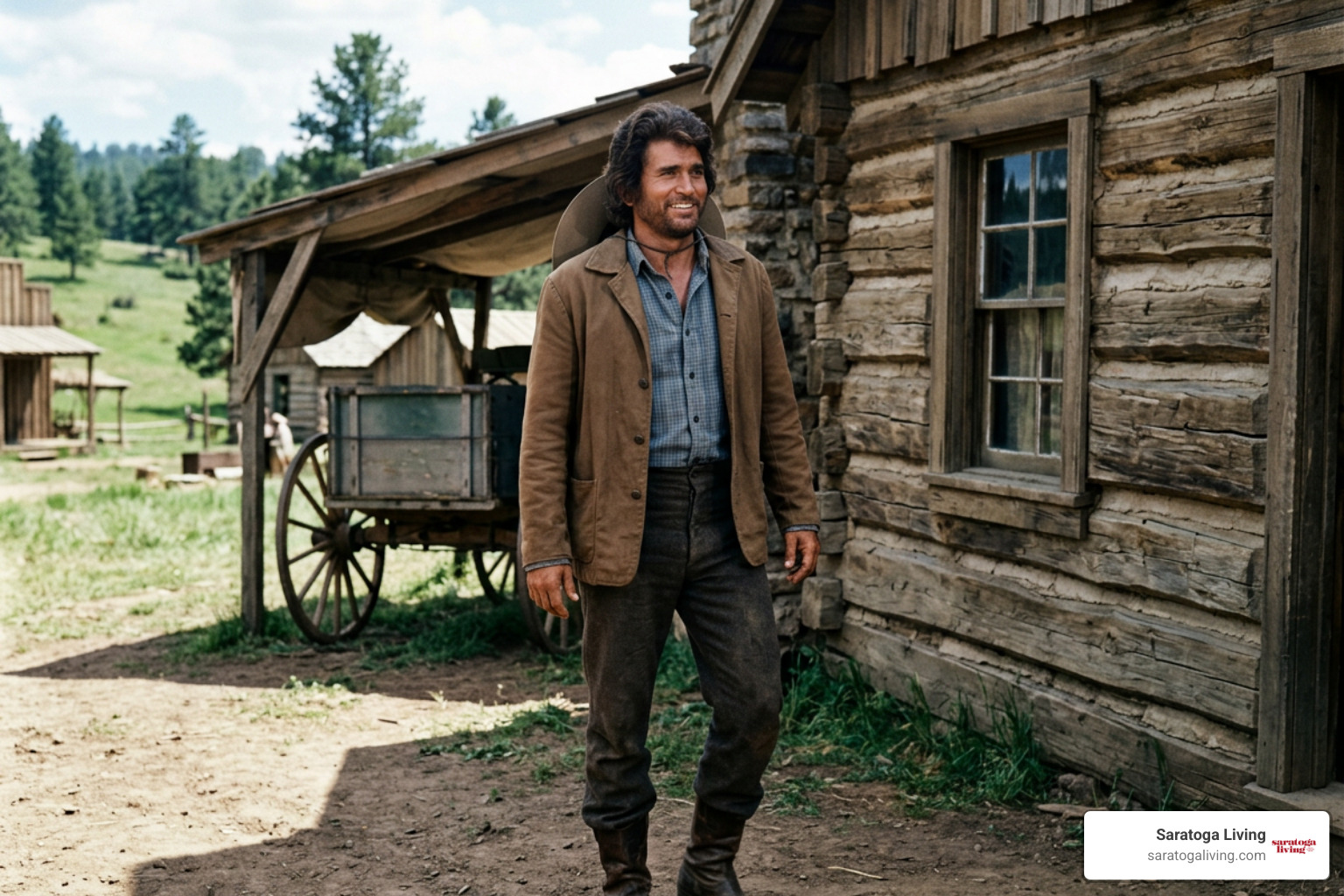
Following the conclusion of Bonanza in 1973, Landon adapted Laura Ingalls Wilder’s classic autobiographical books into the hit drama Little House on the Prairie. Debuting in 1974, the series focused on the frontier struggles of the Ingalls family in late-19th-century Walnut Grove, Minnesota. Landon starred as family patriarch Charles “Pa” Ingalls while serving as the primary executive producer, head writer, and director.
The show was an enormous success, running for nine seasons and 187 episodes. Landon created a tight-knit, collaborative set environment, prioritizing a family-first philosophy. He recognized the pressures faced by child performers and established strict, reasonable production hours to ensure the young cast had time for schooling and play.
Landon formed a lifelong mentorship with Melissa Gilbert, whom he handpicked from hundreds of auditioning actresses to play Laura Ingalls. Gilbert, affectionately nicknamed “Halfpint” by Landon, often spoke about how he embraced young cast members as extended family, inviting them on annual spring break vacations and teaching them the fundamentals of television production.
Highway to Heaven and Creative Autonomy
In 1984, Landon launched Highway to Heaven, starring as Jonathan Smith, a probationary angel sent to Earth by “the Boss” to help people through grief, prejudice, illness, and despair. Landon cast his close friend and frequent collaborator Victor French as ex-cop companion Mark Gordon.
The series marked a historic business milestone: Highway to Heaven was the only television series throughout Landon’s multi-decade career that he owned entirely. Landon financed and produced the show independently, granting him total creative freedom. The show ran for five seasons and 111 episodes, cementing his record of 28 consecutive years appearing weekly on prime-time network television.
Creative Vision: Directing, Writing, and Championing Inclusivity
Beyond his on-screen charm, Landon was an early pioneer of modern showrunning. He commanded every aspect of his productions, from initial script drafts to final sound mixes, as detailed in this comprehensive Michael Landon encyclopedia profile.

Mastering the Multi-Hyphenate Role Behind the Camera
Landon worked with remarkable efficiency. Rather than isolating himself in an office, he often sat in his director’s chair right on the soundstage, penning scripts by hand during lighting setups between takes. His production crews were among the most loyal in Hollywood, working alongside him across Bonanza, Little House, and Highway to Heaven. This continuity allowed his sets to operate like a well-oiled machine, finishing episodes on time and under budget.
He earned two Emmy Award nominations for writing and directing The Loneliest Runner and received a prestigious Spur Award from the Western Writers of America in 1981 for his screenwriting on Little House on the Prairie.
His directing portfolio extended beyond his core series to include television movies such as Where Pigeons Go to Die (1990) and the western series Father Murphy (1981–1983). In early 1991, after a 30-year broadcast run with NBC, Landon transitioned to CBS to write, produce, and direct the pilot film Us, exploring themes of redemption and human connection.
Translating Personal Tragedy into Meaningful Television
Landon’s storytelling was deeply rooted in his real-life experiences. In 1973, his stepdaughter Cheryl was involved in a horrific car collision in Tucson, Arizona, which left her in a deep coma with life-threatening injuries. Sitting in the hospital waiting room, Landon made a personal vow to God: if she survived, he would dedicate his creative career to producing meaningful television that helped humanity and celebrated family values. Cheryl made a full recovery, and Landon kept that promise across the remainder of his life.
Decades before inclusivity became an industry standard, Landon actively integrated marginalized individuals into mainstream television. On Highway to Heaven, he insisted on casting disabled actors to play authentic roles rather than framing them solely through tragedy. He hired adult writers with disabilities, created storylines centering on terminal illness and discrimination, and cast real cancer patients as background extras. Landon understood that television could serve as an emotional release, providing audiences with sincere, tearful catharsis grounded in unconditional love.
Personal Life, Family, and Final Cancer Battle
While Landon presented an idealized patriarch on television, his personal life was complex and deeply human. He navigated three marriages, raised nine children, and continually sought balance between his demanding work schedule and his dedication as a parent. His son’s life and work, detailed in this look at Michael Landon Jr. filmography and career, demonstrate how Landon’s creative and spiritual values carried on into the next generation of filmmaking.
Marriages, Fatherhood, and Mentorship
Landon was married three times:
- Dodie Levy-Fraser (1956–1962): Landon adopted her son Mark and together they adopted another son, Josh.
- Marjorie Lynn Noe (1963–1982): Landon adopted Marjorie’s daughter Cheryl and the couple had four children together: Leslie, Michael Jr., Shawna, and Christopher.
- Cindy Clerico (1983–1991): Landon met Cindy, a makeup artist, on the set of Little House on the Prairie. They had two children together: Jennifer and Sean.
Despite the intense scrutiny surrounding his divorces, Landon remained a devoted father to all nine children. He prioritized family dinners, attended school functions, and encouraged his children to find their own creative callings.
His daughter Jennifer Landon grew up to become a multi-Emmy-winning actress, while Michael Landon Jr. became a successful director, writer, and producer known for family-friendly projects like When Calls the Heart.
Michael Landon’s Cancer Diagnosis, Advocacy, and Final Days
In early 1991, while on a family skiing trip in Park City, Utah, Landon began experiencing severe abdominal pain. Returning to Los Angeles, a CT scan on April 5, 1991, revealed advanced, inoperable pancreatic cancer that had already metastasized to his liver.
Rather than withdrawing from the public eye, Landon invited reporters to his 10-acre Malibu ranch for an open press conference on April 8. With his characteristic humor and warmth, he confirmed his diagnosis, debunked sensationalist tabloid rumors, and announced his determination to fight the disease with everything he had.
In May 1991, Landon made his final public television appearance on The Tonight Show Starring Johnny Carson. He charmed the audience by joking about touching up his prematurely gray hair, poked fun at his holistic dietary regimen of carrot juice and coffee enemas, and spoke candidly about confronting terminal illness without fear.
After receiving one treatment of the standard chemotherapy drug 5-FU, Landon grew skeptical of its chemical toxicity and low historical response rates, shifting his focus to alternative holistic protocols. However, the aggressive cancer advanced rapidly. On July 1, 1991, at age 54, Michael Landon passed away at his home in Malibu, surrounded by his wife Cindy and his nine children. Over 500 mourners attended his memorial service at Hillside Memorial Park in Culver City, California, including former President Ronald Reagan and First Lady Nancy Reagan.
In the decades since Landon’s passing, pancreatic cancer research has evolved considerably. Modern oncology now utilizes comprehensive genomic profiling, revealing that approximately 25 percent of pancreatic cancer patients carry specific genetic mutations responsive to targeted therapies. While five-year survival rates stood at just 4 percent during Landon’s diagnosis in 1991, ongoing research into multi-agent chemotherapy regimens—such as combining Gemzar (gemcitabine) with Abraxane (nab-paclitaxel), or administering FOLFIRINOX—has doubled long-term survival metrics and improved quality of life for patients worldwide.
Frequently Asked Questions About Michael Landon
What was Michael Landon’s real name and why did he change it?
Michael Landon was born Eugene Maurice Orowitz on October 31, 1936, in Forest Hills, Queens, New York. When entering professional acting, he needed a stage name because his birth name was difficult to bill and his first choice, Michael Lane, was already registered with the Screen Actors Guild. He selected “Michael Landon” at random while flipping through a Los Angeles phone directory.
How many episodes did Michael Landon star in across his major TV shows?
Landon starred in 728 total episodes across his three primary network franchises:
- 430 episodes of Bonanza as Little Joe Cartwright
- 187 episodes of Little House on the Prairie as Charles Ingalls
- 111 episodes of Highway to Heaven as Jonathan Smith
This remarkable run gave him 28 consecutive years of weekly, full-hour prime-time television acting—a longevity record that surpassed many of the medium’s greatest legends.
What caused Michael Landon’s death and when did he pass away?
Michael Landon died of complications from inoperable pancreatic cancer that had metastasized to his liver. He passed away on July 1, 1991, at his home in Malibu, California, at the age of 54, less than three months after publicly announcing his terminal diagnosis.
Conclusion
Michael Landon left an indelible mark on American entertainment by proving that kindness, family values, and emotional honesty could dominate prime-time ratings across multiple decades. From his early days overcoming childhood trauma and setting high school athletic records to his ground-breaking transition into a writer, director, and independent producer, he reshaped the television landscape.
Landon used his creative platform to uplift audiences, champion inclusion for performers with disabilities, and remind viewers of the enduring importance of compassion and community. As we look back on his contributions to popular culture, we are reminded that genuine storytelling never goes out of style—much like the cherished gatherings, seasonal celebrations, and classic American traditions and cultural events that continue to bring families together year after year. Michael Landon’s work remains a benchmark for heartfelt television and an inspiring example of turning personal adversity into art that endures.